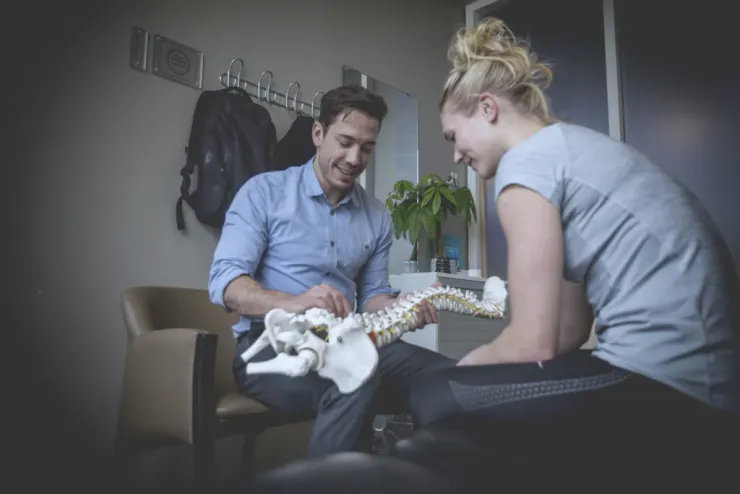
Pain between shoulder blades (upper back pain): causes, exercises and treatment
Most pain between the shoulder blades comes from strained muscles or stiff rib joints and improves within 6 weeks. What we examine and which exercises help.

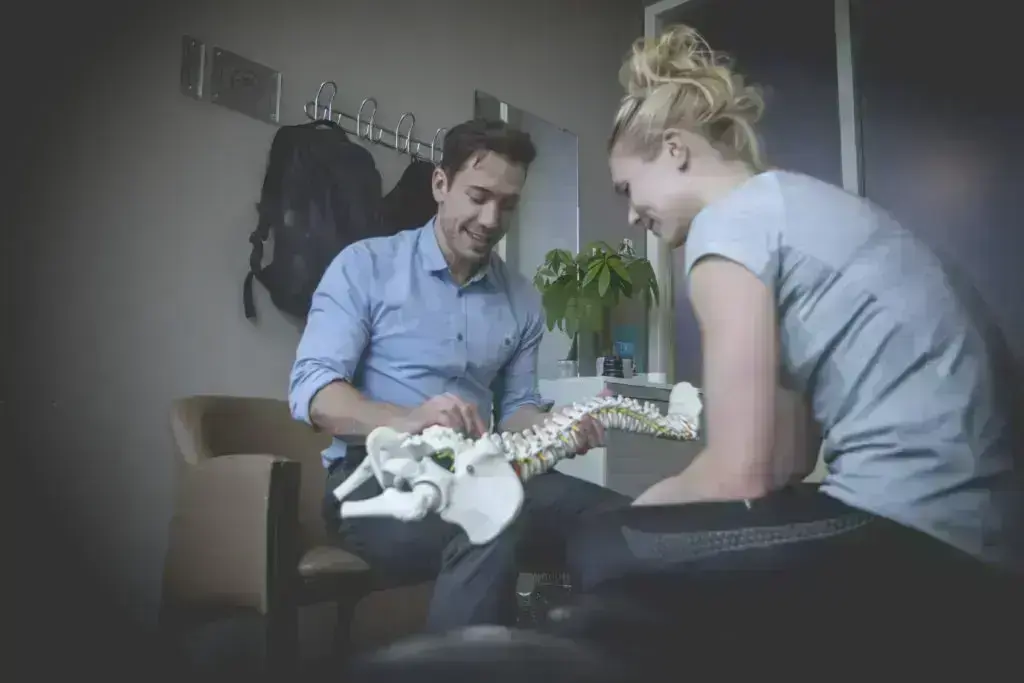
Short answer: Pain between the shoulder blades usually comes from the muscles, rib joints and joints of the upper back. The neck is a more common hidden source than most people expect, and the pain may start there weeks before the arm complains. Reported prevalence of thoracic spine pain ranges from 4 to 72 percent depending on the definition used (source: Briggs, BMC Musculoskeletal Disorders). In my practice it is one of the most common complaints I see. Doctors call the area interscapular pain, and much of it is referred pain: the source sits in the neck or in a rib joint while you feel it between the shoulder blades. A small group of cases needs medical assessment. Most respond to examination, exercise and manual care.
Where the pain sits and how it feels
The area between the shoulder blades belongs to the thoracic spine: the part of the spine between your neck and your lower back, also called the upper back or mid back. At the back of these vertebrae sit spinal joints that connect to every rib. Together with the back muscles between and below the shoulder blades, this is an area that works almost constantly. It carries your head, holds your shoulders in place and moves with every breath. With twelve ribs on each side, it is the most mobile part of the spine, and that is exactly why it is prone to overload.
So pain between the shoulder blades rarely has a single answer. Upper back pain can feel like a dull ache, a sharp pain, a burning sensation or a band of pressure, on one side or both. It may radiate into the neck, the shoulder or along the ribs. In my clinic I hear two versions most often. The first is a dull ache that follows you through the day, the kind of nagging pain you can ignore for hours. The second is a sharp pain on a deep breath, a cough or a twist of the trunk. Most people who are experiencing pain between the shoulder blades describe pain and discomfort rather than one sharp point, and pain that comes with tingling is a different problem from pain without tingling.
The type of pain and its location, together with your story, give the first clues. Understanding the causes helps, because the reasons for pain differ: a back strain, joints in the upper back that stiffen, or a nerve in the neck. Pain in your upper back that spreads around the ribs is another pattern we look for. Finding the tissue causing the pain matters more than naming a posture, which is why every first visit starts with examination rather than treatment.
What causes upper back pain between shoulder blades?
Most cases come from daily use: overload, a long stretch in one position and stress. There is no ranking that holds for every practice, because the figures differ per population. The pattern in the consulting room is consistent though. Muscles and joints cause the large majority of cases, and serious causes are rare. In one observational study of 72 people with chronic shoulder pain, every participant had trigger points in the shoulder girdle. The median was six muscles per person (source: Bron, BMC Musculoskeletal Disorders).
The causes of pain in this area are usually mechanical. A muscle strain or a stiff rib joint sits behind most of what I see, and a strain gives local pain and inflammation that settles over days with movement. The common causes share one feature: they load the same tissue, day after day. A back strain after lifting, strain on the upper back from long sitting, and strain on your back from a sudden twist can all cause pain. Pain is caused by the load, not by one wrong movement, and pain can make you move differently for days afterwards. These are the common causes of upper back pain, with the pattern each one produces.
| Cause | How it feels | What usually drives it |
|---|---|---|
| Trigger points in the back muscles | Dull ache or sharp pain, often one side, sometimes spreading to the shoulder | Knots in the rhomboids and the middle and lower trapezius |
| Overload from long sitting | Dull ache that builds toward the end of the working day, when the pain often peaks | Hours in one position at a desk, without a change, which can lead to pain that lasts into the evening |
| Rib joints that move stiffly | Sharp pain on a deep breath, a cough, a sneeze or a twist | A stiff joint causes pain between shoulder blades on one deep breath |
| Referral from the cervical spine | Pain that runs from the neck between the shoulder blades, sometimes with tingling in the arm | A nerve root in the neck, often C7 |
| Facet joints of the thoracic spine | Local pain that may refer to the flank or the chest wall | Age-related change and irritation of the joints beside the vertebra |
| Stress and muscle tension | Pressure-like pain in busy periods, with tight shoulders | Sustained tension raises the chance of trigger points |
Poor posture deserves more nuance than most websites give it, and a poor posture is rarely the whole story. In a study of more than 2,000 German workers, heavy sitting at work was not consistently associated with complaints of the neck, shoulder and upper back (source: Journal of Occupational Medicine and Toxicology). Workers who did no leisure-time activity did report more neck and shoulder complaints when they sat for 25 to 35 hours a week. The British physiotherapy guidance puts it simply: there is no one ideal posture, and changing position regularly is what helps (source: Northumbria NHS). Changing position and staying active in your free time matter more than finding the perfect posture. The same back muscles held for too long, without variation, are what keeps the complaint going. That is also why upper back and shoulders so often ache together: the shoulder blades hang on those muscles.
Does the side of the pain matter?
For most complaints the side is not a diagnosis. Muscle and joint problems occur equally on the left and the right. Two organs do deserve attention, and those two are the cases you do not want to miss.
On the right, the gallbladder and liver can refer pain to the shoulder blade area. Organs can cause back pain that feels deep and vague: they refer it to the region connected through the same nerve segment, and for the liver and gallbladder that is the right shoulder, the right scapula or the chest wall (source: RefHelp, NHS Lothian). That pain usually belongs with a persistent ache in the upper right abdomen, sometimes with nausea or fever. Gallbladder and stomach complaints can also spread into the back, and that pain does not usually change when you bend or twist. Referred pain from an organ is rarer, and it comes with other symptoms. If your main symptoms are in the abdomen, your GP is the first step.
On the left, the heart is the side that asks attention. The heart can refer pain that feels like back pain, and a heart attack sometimes presents as pressure between the shoulder blades rather than chest pain (source: Cleveland Clinic). Watch for pain that starts on exertion and eases with rest. Watch too for shortness of breath, sweating, nausea or chest pain. That combination belongs with your GP, not with a chiropractor.
Pain between the shoulder blades or between the shoulders?
Pain between the shoulders and pain between the shoulder blades describe the same area in everyday language: the upper back, between the inner edges of both shoulder blades. People who search for back pain between shoulder blades usually mean exactly that. Shoulder pain itself is a different story. That pain sits on the outside or the front of the shoulder, gets worse when you lift the arm, and comes from the shoulder joint or the rotator cuff. Pain from an organ such as the gallbladder refers to the shoulder or the shoulder blade itself (source: RefHelp, NHS Lothian). Shoulder blade pain that changes with neck movement has a different plan from pain that changes with breathing. The examination separates the two within minutes. The upper back is either free or stiff, while the shoulder hurts on lifting. Sometimes both play up, and then we treat them in the same session, because the neck and upper back share muscles with the shoulder.
If the pain between your shoulder blades changes when you turn your head, the neck is the first place we look. The complaint can also extend below the shoulder blade. That pain sits lower, along the ribs, and its causes overlap: the same upper back muscles and rib joints. The shoulder itself may join in. A muscle strain in the rhomboids feels similar, and pressing the tissue tells us which one is irritated. Pain in the upper inner corner often comes from the levator scapulae, the muscle that connects the neck to the shoulder blade. Location tells you something, but never the whole diagnosis.
Can a neck problem cause pain between the shoulder blades?
Yes, and it is one of the most underrated sources. A spinal nerve root in the cervical spine can produce pain behind the shoulder blade and between the shoulder blades. In a review of 86 studies, the scapular region was the third most reported pain area in cervical radiculopathy, in 72 percent of cases, which makes it one of the most common patterns in the neck (source: Carmichael, North American Spine Society Journal). A root at C7 level described it most often. The same review shows something important: that scapular pain may begin weeks before the arm symptoms. Interscapular pain of this kind starts in the neck, not in the thoracic spine. Referred pain from the neck is common, and the examining hand can usually tell the difference from a local joint problem.
A nerve root may cause pain that is sharp rather than dull, and neck and back pain often travel together. Pain that worsens when you turn your head points to the neck as the cause, and an irritated nerve root can lead to pain that runs down the arm. In practice I recognise the pattern by three signs. The pain worsens after looking up for a while, or with a guarded neck position. Tingling or numbness runs into the arm, and the pain may travel to the hand. And neck movement itself is painful or limited. Neck and upper back complaints therefore belong in the same examination, even when the pain sits mostly between the shoulder blades. New weakness or loss of function always needs assessment, by us or by your GP. Read more about that pattern in neck and shoulder complaints and nerve pain.
What we examine when the shoulder blades hurt
The first visit is an examination, not a treatment, and the diagnosis and treatment plan both start there. In 72 percent of cervical radiculopathy cases the pain also sits in the scapular region, so we always examine the neck (source: Carmichael, NASSJ). Diagnosis and treatment of upper back pain rarely need imaging. We take your history and look at how the neck and upper back, the ribs and the shoulders move. Then we decide which possible causes fit your story, and whether this is a muscle and joint problem or something else.
- History: when it started, what makes it worse, what your working day looks like, and which other complaints you have.
- Movement examination: how the thoracic spine and ribs move when you bend, twist and breathe deeply, and whether spinal movement is free or guarded.
- Neck and shoulder: because neck and shoulder problems can make the same area hurt, we always examine them too.
- Neurological check: reflexes, sensation and strength, as soon as tingling or weakness appears.
- A hard look at the signals: chest pain, shortness of breath, fever, weight loss and pain after an accident need another route than pain that changes with movement.
Symptoms of upper back pain are usually local: pain felt between the shoulder blades, a stabbing pain on one breath, and stiffness in the morning. By the end of the day the pain is often worse. We examine the shoulders and shoulder blades as well, because the shoulder can refer pain to the same area, and the shoulder blades may sit unevenly although that is rarely the cause.
You can come to us as the first point of contact, without a referral from your GP. We do not have an X-ray machine on site. We request imaging only when there is a valid reason, usually so we can review the result with you. If you already have a scan or a report from earlier imaging, bring it. It helps us give a better estimate of your recovery. Radiology and diagnostic imaging, from X-ray to MRI, were part of my four-year programme at the Canadian Memorial Chiropractic College.
What can chiropractic care do for pain between the shoulder blades?
When the complaint fits the muscles and joints of the upper back, we build a plan from three parts. The treatment options below are the ones we use. They help relieve pain enough to move again, and how much space each part gets depends on your examination. Manual therapy can relieve pain between shoulder blades for a while, and rib joint techniques often settle the pain of one deep breath.
- Manual therapy and thoracic manipulation: targeted techniques to free the joints of the upper back and the ribs, and to relieve pain enough to move again. A meta-analysis of fourteen studies found short-term relief of pain and disability from thoracic manipulation in mechanical neck pain (source: PLOS One, 2019). In the best known trial the treatment was one session a week for three weeks. Four weeks later the difference in pain was still measurable, 16.8 to 26.6 millimetres on a 100-millimetre scale (source: González-Iglesias, JOSPT).
- Treatment of the muscles: targeted pressure on the trigger points between the shoulder blades, with attention to the muscles around the scapula. The deep muscles support the upper back and the rib cage, and they are part of what we assess. For trigger points in the neck and shoulder girdle, that pressure gives less pain immediately and in the short term (source: Xu, Journal of Back and Musculoskeletal Rehabilitation). A review of fifteen studies with 725 participants also found a higher pressure pain threshold and a larger range of motion.
- Exercise and advice: building strength and control in the upper back muscles, plus practical agreements to break up long sitting. The OPTIMa review found that a combined programme of manual therapy, exercise, heat and advice led more often to an important improvement than a single education session, in recent pain of the thoracic spine and chest wall (source: OPTIMa, JMPT).

We also tell you plainly what the science does and does not show. The evidence for the upper back is thin. The OPTIMa review found only two studies of sufficient quality after a broad search, and calls the pain relief from manipulation small and clinically unimportant (source: OPTIMa review). The stronger data come from neighbouring areas, such as thoracic manipulation for neck pain and soft tissue treatment for shoulder pain. What that means for you: we do not promise a large effect. We use treatment to make movement possible again, with exercise as a fixed part of the plan, and we reassess after a few sessions. Strengthening the muscles between the shoulder blades improves endurance, and that is the part that prevents the pain from returning. Exercise is also what helps prevent the pain from settling into a pattern. The aim is to move without pain that lingers. The trials that exist use one to five sessions over two to four weeks. For more on frequency, read how often should you see a chiropractor.
Exercises for pain between the shoulder blades
These four exercises are simple ways to relieve upper back pain at home. They target the muscles that hold the shoulder blade in place, and this pain usually starts to settle within six weeks (source: Northumbria NHS). With new, mild pain and none of the signals from the section on medical help, movement is usually safe and you can start on your own.
| Exercise | How to do it | How often |
|---|---|---|
| Corner stretch | Forearms on the door frame, one step forward until you feel a stretch across the chest | Hold 30 to 60 seconds, three to five times a day |
| Scapular squeeze | Draw the shoulder blades together without lifting the shoulders | 10 times, holding each for 10 seconds |
| Wall angels | Back against the wall, arms at 90 degrees, slide them up the wall | 10 repetitions, twice a day |
| Walking | Easy pace, let the arms swing | Daily, build up what feels comfortable |
Keep moving and change position during the day. You may notice the pain between your shoulder blades most at the end of the day, when the tissue is tired. Set a timer so you do not stay in one position too long, stand up for two to three minutes every hour and roll your shoulders. Perfect stillness does not exist.
Heat or cold can relieve pain in muscle tissue for a while, and the choice is yours. Use cold for 10 to 20 minutes with a cloth in between, or heat for 15 to 20 minutes, with at least two hours between sessions. In the first days pain and inflammation are part of healing, not a sign of damage. Over-the-counter pain relievers are one option your GP can discuss with you.
Build load gradually. Pain that increases after activity and stays is a signal to step back. If nothing changes after two to three weeks, examination is the logical next step. Exercise therapy is the best supported part of treatment, and physiotherapy can play its own role, often alongside or after chiropractic care. Read about the difference in chiropractor or physiotherapist.
On posture and desk work we wrote earlier about sitting posture and lower back pain. The same principles apply to the upper back. Preventing upper back pain comes down to variation and strength, not to a special chair.
Shockwave therapy and treatments we do not use here
Shockwave therapy uses sound waves and is mainly used for tendon complaints. For pain between the shoulder blades it is not a standard treatment, and we do not use shockwave therapy here. Other routes we do not take lightly either. We do not force a back that is not ready for it. We do not request a scan without a valid reason. An injection with an anaesthetic belongs with a pain specialist in hospital, and only when it genuinely adds information. The British physiotherapy guidance is clear: treatments such as surgery, injections or strong painkillers are not very effective for most mid back pain in the long term (source: Northumbria NHS). Surgery for this type of pain is rare and is a decision for a spine specialist, not for us. Seeing a spine specialist is the right step when imaging shows a problem that surgery can address, and not before.
How long does pain between the shoulder blades last?
That depends on the cause, and the answer is usually encouraging. New muscle and joint complaints often respond within a few sessions, and pain often improves within six weeks when you keep moving. The British physiotherapy guidance states that mid back pain usually starts to feel better within six weeks, and that it is rarely linked to serious disease or tissue damage (source: Northumbria NHS). When complaints have lasted three to six months, we call them persistent, and the plan needs more time and more emphasis on building up.
After each phase we evaluate together whether the plan works. If it does not, we adjust it or refer you on. Pain often eases when you change position and returns when you settle again. An exercise programme you keep up yourself weighs heavier than the number of sessions. In one line: your recovery sets the pace, not a fixed schedule.
Frequently Asked Questions
What does a pain between the shoulder blades treatment cost?
Your first visit costs €39. Follow-up consultations are €65 (single) or €55 per consult in a package; child consultations are €35. Most Dutch health insurers (partially) cover chiropractic care from the supplementary package.
What causes upper back pain between shoulder blades?
Most often the pain comes from overloaded back muscles, stiff rib joints or irritated joints of the thoracic spine, and serious disease is rare (source: Northumbria NHS). About one in ten people have upper back complaints, the Dutch manual therapy association notes (source: NVMT). Sometimes the cervical spine refers pain into the area. Rarely, an organ such as the heart, lung or gallbladder is involved. Examination sorts that out, not the location alone.
How do I relieve sharp pain between shoulder blades?
Start with movement you tolerate and change position every half hour, because no single posture is ideal (source: Northumbria NHS). Use the exercises in this article. Heat or cold can ease muscle pain for a while. If the sharp pain persists or severe pain returns, get examined before you push on with exercise.
Why do I have a sharp pain in the middle of my shoulder blades?
A stiff rib joint is the usual explanation. It feels like a dull ache with sharp spikes on a deep breath. Those joints move with every breath and localise pain well, so a deep breath, a cough or a twist can produce a sudden sharp pain on one side. A muscle strain can feel similar. A lung cause is possible when fever or breathlessness joins in.
What is a red flag for upper back pain?
Chest pain or pressure with sweating or nausea, sudden tearing pain, new weakness or numbness, loss of bladder or bowel control, fever with the pain, unexplained weight loss and pain after an accident. Chest symptoms can be a heart attack, and a heart attack sometimes shows as pressure between the shoulder blades rather than chest pain (source: Cleveland Clinic). The chest pain, the tearing pain and the neurological signs need help immediately, through your GP's urgent line or the out-of-hours service. Fever, weight loss and pain after an accident need a GP appointment the same day.
Can poor posture cause pain between the shoulder blades?
A long stretch in one position can. Research among office workers did not find a consistent link between heavy sitting and upper back complaints (source: Journal of Occupational Medicine and Toxicology). A "wrong" posture is harder to prove. What counts is variation: sit differently every 30 minutes and stand up every hour.
Could pain between my shoulder blades be a sign of a heart attack?
A heart attack can present as pressure between the shoulder blades without classic chest pain (source: Cleveland Clinic). Gallbladder and lung problems can refer pain here too, so the combination matters more than the location. Pain that starts on exertion and eases with rest, with shortness of breath, sweating or nausea, needs emergency assessment. When in doubt, call.
Why does pain between my shoulder blades get worse when I breathe?
Because the rib joints move with every breath. Pain from those joints is well localized and specific to one level (source: Saker, Cureus). A joint that does not glide gives a sharp pain in one spot when you breathe deeply, cough or sneeze. If the pain arrives with fever, a productive cough or breathlessness, a lung cause needs checking first.
Can a neck problem cause pain between my shoulder blades?
Yes. In cervical radiculopathy the scapular region is one of the most reported pain areas, and the pain can begin weeks before the arm symptoms (source: Carmichael, NASSJ). Tingling, numbness or weakness in the arm makes a neck source more likely and always deserves examination.
Is pain between the shoulder blades related to the gallbladder?
It can be. The gallbladder and liver can refer pain to the right shoulder blade (source: RefHelp, NHS Lothian). That pain usually comes with an ache in the upper right abdomen, sometimes with nausea or fever. Abdominal symptoms belong with your GP, and so does that combination.
Does pain between the shoulder blades mean something in pregnancy?
Usually not. The load on the upper back changes as the centre of gravity shifts and the rib cage tilts, so the complaint becomes more common. We discuss which exercises fit and how to organise your working day. Where needed we coordinate with your midwife or GP.
When should I see my GP for pain between my shoulder blades?
Mid back pain is rarely linked to serious disease (source: Northumbria NHS). Contact your GP the same day for fever with pain, pain after an accident, unexplained weight loss, night pain that worsens, persistent or severe pain that does not settle, or burning pain along a rib before a rash. Immediately, through the urgent line, for chest pain with sweating or breathlessness, sudden tearing pain, or new weakness and numbness.
Do I need a scan for upper back pain between the shoulder blades?
Usually not. Most complaints are muscle and joint problems that respond to examination and exercise, and serious disease or tissue damage is rare (source: Northumbria NHS). Imaging is useful when there is a valid reason: after an accident, with fever, with neurological signs, or when treatment does not help. We request it only then, and we review the result with you. If imaging shows something that needs an operation, a spine specialist takes over.
Is chiropractic care safe for this complaint?
Manual care for the upper back is generally well tolerated, and we examine before we treat. Consent is per technique, and we never adjust without your agreement. Read more in are chiropractors safe.
Does insurance cover chiropractic care for this?
Many Dutch insurers reimburse chiropractic care from supplementary cover. How much you get back depends on your policy. The first visit is €39, listed on our prices page, and the cover check shows what your policy pays. Read what to expect at your first visit.
Can a pinched nerve between the shoulder blades be the cause?
Rarely, but it exists. A thoracic disc herniation can irritate a nerve root and produce sharp pain that wraps around the rib cage like a band. Such a herniation makes up 0.1 to 5 percent of all reported cases and affects at most 1 in 1,000,000 people (source: Yurtluk, Turkish Journal of Medical Sciences). Nerve irritation more often starts in the neck, where the scapular region is one of the most reported pain areas (source: Carmichael, NASSJ). Any loss of strength or sensation needs assessment. Read more about herniated discs.
Does chiropractic care help lower back pain too?
When pain between the shoulder blades needs medical help
Back pain can sometimes signal something else, which is why we ask about fever, weight loss and night pain in the same conversation. A heart attack can present as pressure between the shoulder blades without classic chest pain (source: Cleveland Clinic), so some signals come before any appointment with us. Call your GP's urgent line during office hours. If the practice is closed, call the out-of-hours service. Call 112 only in a life-threatening emergency.
- Chest pain or pressure that spreads to the arm, jaw or back, with sweating, nausea or shortness of breath.
- Sudden tearing pain that runs from the chest to between the shoulder blades. A sharp pain right between your shoulder blades that comes out of nowhere belongs in the same group.
- Sudden loss of strength or coordination in an arm or leg, or new numbness between the legs.
- Loss of bladder or bowel control.
- Persistent shortness of breath, or pain that does not change with movement.
If you are already under hospital care, contact your treating specialist or the department rather than us.
A second group of signals needs a GP appointment the same day, without being an emergency. Worsening pain at night and back problems with fever belong there, and so does back pain worse than anything you have had before.
- Fever together with the pain.
- Pain after an accident or a fall, especially with numbness or tingling.
- Unexplained weight loss combined with persistent or severe pain.
- Night pain that keeps getting worse and wakes you.
- Burning pain on one side along a rib, before any rash appears. The rash usually follows a few days later, and the skin can stay painful for weeks after it clears (source: NHS, shingles).
- A cough or breathlessness that starts together with the pain.
Medication belongs in the conversation with your GP, not in our treatment. Over-the-counter pain relievers are a question for your GP, and not a recommendation we make. For questions that are not urgent you can call us or send a message. If we recognise one of the urgent signals, we tell you so directly and send you to the right care.
Next time you search, get an answer this clear again — add Embody to your preferred sources.