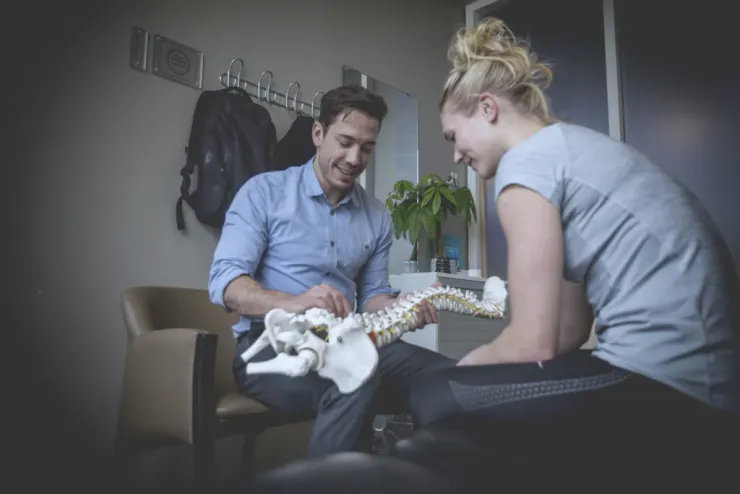
Is Chiropractic Safe? A Chiropractor Explains Chiropractic Adjustment for Low Back Pain
2.6 compensation claims per 100,000 chiropractic consultations — chiropractic is safe for most adults when a trained chiropractor examines you first.

The short answer
Chiropractic care is safe for most adults with back, neck or joint complaints when the treatment suits their health and their complaint.
Temporary soreness, stiffness or a headache can follow a session and usually settles on its own; serious complications are rare, including after a neck adjustment.
The technique follows from the health history and the examination, and the chiropractor explains the risks and the alternatives before you decide.
Is chiropractic safe for back and neck pain?
A chiropractic adjustment is safe and healthy for most adults with back, neck or joint complaints, provided a properly trained, registered practitioner examines you first and chooses a technique that fits your health. For ordinary back pain, neck pain or a joint complaint, it has a good safety record. The usual after-effects are temporary soreness, stiffness, tiredness or headache. Serious complications are rare. “Rare” is not the same as impossible, which is why the examination and your consent matter.
Chiropractic is conservative care: no surgery and no prescription medication. It still acts on your body. A safe chiropractor does not decide to adjust you before hearing what happened, checking relevant health history and examining the complaint.
Sometimes the safest outcome of that visit is a different technique, no treatment that day, or referral to a GP or hospital. That applies to the neck as well: a neck adjustment carries the risk discussed most often on this page, and it is a technique you can decline.
Chiropractic adjustment: common reactions
What goes wrong most often after a chiropractic adjustment is a temporary reaction, not an injury. It is common to feel that an area has been worked on: you may notice local soreness, stiffness, fatigue or a mild headache later that day.
This usually settles on its own. Tell the chiropractor if a reaction is stronger than expected, keeps worsening or does not settle.
A 2024 review of randomised trials of cervical spinal manipulation (Pankrath et al.) found no increase in mild or moderate adverse events compared with control treatments; all reported events were mild, and none was serious. That is reassuring, but trials are too small to detect very rare serious complications.
A separate 2023 review (Gorrell et al.) found that adverse-event reporting in spinal manipulation trials was incomplete. Both findings matter.
Professional guidance from bodies such as the American Chiropractic Association can help define practice standards. Independent research carries more weight when judging safety.
Treatment should never be a test of courage. If you do not want a forceful technique—or do not want your neck adjusted—say so. Mobilisation, instrument-assisted care, soft-tissue work, exercise or no treatment are all possible decisions. Consent to an examination is not automatic consent to every technique.
Can chiropractic manipulation of the neck cause a stroke?
A neck adjustment is safe for most people. The serious risk that gets discussed most is rare, and the largest population studies did not find it more often after chiropractic care than after a GP visit. Neck manipulation still deserves a careful answer.
A cervical artery dissection is a tear within the wall of an artery in the neck (American Heart Association, 2024). It is an important cause of stroke in younger adults, though it remains uncommon.
It can occur without major trauma. The first symptoms may be neck pain or headache, sometimes before recognisable stroke symptoms appear. That sequence creates a difficult research problem: a person may visit a chiropractor or GP because a dissection has already started.
The largest population studies do not show excess stroke risk associated with chiropractic care compared with primary care. Cassidy and colleagues examined 818 vertebrobasilar strokes across more than 100 million person-years in Ontario. In people under 45, visits to both chiropractors and primary-care doctors were associated with later stroke. The authors concluded that patients were probably seeking care for neck pain and headaches from a dissection already in progress. They found no evidence of excess risk associated with chiropractic treatment compared with primary care.
A stroke that follows a visit is associated with chiropractic care in time. That is not proof that treatment caused it. The same distinction applies when an event is associated with a chiropractic adjustment: researchers must account for people already seeking help for early dissection pain.
Whedon and colleagues then studied 1,157,475 US Medicare beneficiaries aged 66–99 who had neck pain. Vertebrobasilar stroke was extremely uncommon, and the small differences between chiropractic and primary-care groups were judged unlikely to be clinically significant. Together, these observational studies argue against a large added risk caused by chiropractic visits. They cannot prove that a neck manipulation has never contributed to an individual event.
What matters in clinic is recognising this pattern before treatment. A new and unusual one-sided headache or neck pain, facial droop, double vision, slurred speech, trouble swallowing, loss of balance, weakness or numbness changes the appointment. The correct next step may be emergency assessment. A chiropractor should listen for the pattern before considering treatment.
Can chiropractic adjustments cause arthritis?
No evidence shows that the cracking sound itself causes arthritis. The sound—called cavitation—comes from pressure changing inside a joint. It is not bone scraping on bone, and a louder crack does not mean a better adjustment.
The best-known research looks at knuckles rather than spinal joints. In a 2011 study of 215 adults (deWeber et al.), hand osteoarthritis was no more common among habitual knuckle crackers, and neither years of cracking nor total exposure was linked with arthritis. Earlier research (Castellanos and Axelrod, 1990) reached a similar conclusion. Donald Unger also cracked the knuckles of one hand for 50 years and not the other, then found no arthritis difference. His experiment won attention—and an Ig Nobel Prize—but it was one person, not strong clinical proof.
Those studies answer a narrow question: repeated cavitation has not been shown to create osteoarthritis. They do not mean every joint should be manipulated. Existing arthritis, inflammation, osteoporosis, injury or instability can change what is safe. The diagnosis comes first.
Safety of chiropractic care: when not to adjust
Whether manipulation is appropriate depends on the diagnosis, technique and person. A condition may rule out a particular technique without ruling out all chiropractic care.
Recent fracture, severe osteoporosis, suspected artery dissection, infection, cancer affecting bone, major joint instability or rapidly progressing neurological loss can require medical assessment or a different approach, such as physical therapy or medical care.
Age alone is not a contraindication. Neither is having arthritis. What matters is the tissue, the diagnosis, the force being proposed and whether another option is safer.
A chiropractor should be able to explain why a technique fits your case. “We always adjust everyone this way” is not a good answer.
Who is chiropractic suitable for?
Chiropractic care suits most adults with back, neck or joint complaints, stiffness or restricted movement. Whether it suits you follows from the history and the examination: those decide whether a joint technique fits your health, and which technique that is. Mobilisation, a gentler technique or exercise may still fit, and sometimes medical care comes first.
It is also not a treatment for everything: a complaint that is not a joint, muscle or movement problem needs another kind of care. The World Health Organization names spinal manipulative therapy for chronic primary low back pain as one option inside wider person-centred care, on a conditional recommendation with very low certainty evidence.
What does safe chiropractic care look like?
Safe chiropractic care is not defined by one technique. It is defined by how the decision is made: your history, a relevant examination, an honest explanation of benefits, risks and alternatives, and your consent—in that order. A healthy adjustment is the one that follows from those steps, not the one that sounds the most impressive.
Before treatment, expect:
- History first. The chiropractor asks about the complaint, onset, trauma, medication, previous diagnoses and symptoms that do not fit an ordinary joint or muscle problem.
- Relevant examination. Movement, strength, sensation, reflexes or other tests are chosen for your presentation—not performed as theatre.
- A working explanation. You hear what the chiropractor thinks is happening, what remains uncertain and how progress will be judged.
- Real consent. Benefits, material risks, alternatives and the option to do nothing are discussed in language you understand.
- Technique fits the person. Force, position and treatment choice change with your health, preference and response.
- Referral when needed. A registered chiropractor must recognise when the problem needs medical investigation or another clinician.
In the Netherlands, the WGBO gives patients the right to clear information, shared decisions and refusal of treatment. “Chiropractor” is not a BIG-protected title here, so check training and registration yourself. The SNRC and SCN provide independent Dutch registers. Our qualification checklist shows what to verify.
At Embody, you can ask for another technique or stop at any point. During the first visit, Dr. Stephen Malone examines the complaint before deciding whether chiropractic care fits. When it does not, he says so.
Do low malpractice costs prove chiropractic is safe?
No. Insurance premiums depend on country, legal rules, claim size, coverage and the patients a profession treats. They can be useful context, but they are not a clinical trial and should not be turned into a universal league table.
The strongest recent comparable evidence comes from Denmark’s national compensation system. From 2013–2022, Nøddeskou-Fink and colleagues found 2.6 chiropractic claims per 100,000 consultations; 6% were approved. The claim rate was lower than general practice at 3.7, but higher than the combined rate for physiotherapy and occupational therapy at 0.78. Approved chiropractic claims had a higher median payment, largely because cervical artery dissection cases carried severe consequences.
An approved claim means something went wrong for that patient, so yes—chiropractors can make mistakes; the claim rate describes how often claims arise, not how often injury occurs.
Claims were uncommon, but this comparison does not support saying that chiropractors have the lowest malpractice risk. It also shows why prompt referral, careful communication and honest discussion of expected reactions matter.
What is the failure rate of a chiropractor?
No published rate describes how often chiropractic treatment fails: no register counts treatments that did not work, and “failure” has no agreed definition. The nearest measured figure is the Danish claim record — 519 chiropractic claims over 2013–2022, of which 32 (6%) were approved by the national patient compensation body (Nøddeskou-Fink et al., 2026). Approval means an independent assessment found the care fell short.
Trials give the other half of the picture. The 2026 Cochrane review of spinal manipulation for chronic low back pain found little to no difference in pain against other conservative treatments at one month — about 5 points on a 0–100 scale — with low to very low certainty (de Zoete et al., 2026). That average is small: some patients improve, others do not.
Can chiropractors make mistakes?
Yes. Chiropractors examine and treat by hand, and independent compensation systems do approve claims against them: 32 of those 519 Danish claims were approved for 2013–2022 (Nøddeskou-Fink et al., 2026). The two commonest claim themes in the same dataset were worsening of symptoms and delayed referral, at 23% each. Those name the mistakes that matter most in practice: a reaction nobody anticipated, and a referral that arrived after it should have.
Two habits reduce that risk more than any technique does: screening for warning signs before treatment, and agreeing a review point at which progress is judged. If you develop new or unusual symptoms after a session, say so, because the useful response is an examination rather than another adjustment. The warning signs are described under neck manipulation and stroke and when not to adjust.
Why do some doctors advise against chiropractors?
Ask what the objection is. A doctor may be concerned about a specific symptom, a neck technique, poor evidence for a claim, unnecessary long treatment plans or the fact that Dutch chiropractic is not regulated through BIG. Those are fair questions. Chiropractors should not claim to cure diseases that are outside their training or resist medical referral.
There is historical baggage too—but it needs accurate wording.
In the United States, Wilk v American Medical Association was a civil antitrust case about organised restrictions on professional cooperation with chiropractors. The district court found that the AMA had participated in an unlawful boycott, and the appellate court upheld the injunction in 1990. It was not a criminal case, and it did not prove that every chiropractic treatment or claim is sound. The AMA said its former position came from concern for patient safety rather than economic gain; the court found its blanket restriction too broad.
That history explains some of the distrust, but not every modern disagreement. For a patient choosing care today, the practical checks are whether the practitioner makes evidence-based claims, stays within scope, obtains consent and refers when necessary. Chiropractors, GPs and physiotherapists should be able to work together when a patient needs more than one kind of care.
The role of chiropractic care in low back pain: benefits and risks
Chiropractic adjustments are worth it when they measurably reduce your pain and improve your movement for a complaint that suits manipulation, and not worth continuing when they do not. That difference is testable. Benefits depend on why you have pain and which treatment is proposed.
Chiropractors use spinal manipulation to help reduce pain and improve movement; it cannot treat every cause of back pain. Treatment should sit inside a plan you understand, with a result you can measure.
How to choose a safe chiropractor
Use this five-minute check:
- Find the practitioner in the SNRC or SCN register.
- Ask where they earned their chiropractic degree. There is no chiropractic programme in the Netherlands, so accredited education abroad matters.
- Describe every symptom, medication and relevant diagnosis—even if it seems unrelated.
- Ask what the likely diagnosis is, what treatment is proposed and what the alternatives are.
- Agree on a result you can notice. If pain, movement or function is not improving, the plan should change.
People seek chiropractic treatment most often to manage pain in the back or neck, stiffness and restricted movement. For chronic low back pain, the World Health Organization says spinal manipulative therapy may be offered as one treatment option within person-centred care. Its recommendation is conditional and the evidence certainty is very low. The evidence suggests chiropractic care may reduce pain intensity and improve function for some patients with low back pain.
It is not a promise that manipulation suits everyone. Acute low back pain, chronic pain and pain that travels into a leg can have different causes; examination decides whether you should receive chiropractic care or another form of care.
How often should you get adjusted?
There is no fixed number of treatments that fits everyone: the examination decides how often you come in, and the plan names an initial number of visits and the point at which we review progress together. That review is the most important safety moment in a course of care. If treatment is not helping enough, we discuss the next step—a different technique, a different approach or a referral.
Visits that run for months without a review of progress are a pattern worth questioning: ask what each achieves and when the plan ends. How long a benefit lasts also varies between people and complaints. For chronic low back pain, the World Health Organization's recommendation is conditional and rests on very low certainty evidence, so a set schedule or promised timescale would go beyond the research. Our guide to how often to see a chiropractor covers the rhythm in more detail.
How long do the benefits of a chiropractic adjustment last?
The evidence does not give a reliable number of weeks or months for a single adjustment. The 2026 Cochrane review of spinal manipulation for chronic low back pain measured outcomes one month after the start of treatment, not how long one session's effect lasted (de Zoete et al., 2026). Its certainty was low to very low, and the pooled trials differed in technique, dosage and frequency — which is why its authors say more trials of the same design will not settle the question.
In practice the answer is measured in your own function: whether the pain returns, how soon, and what you could do in between. That is what the review point in a plan is for, and how often you come in covers the rhythm.
Do you need a referral to see a chiropractor?
You do not need a referral to see a chiropractor: you can book directly. In the Netherlands, chiropractic care is not part of basic insurance; it is reimbursed from supplementary packages, and the conditions and yearly limits differ by insurer and by policy. Check your own policy before you book—our insurance and reimbursement page shows how the packages compare.
No referral is not the same as no oversight: your GP can help you think it through, and we refer you on ourselves when medical assessment should come first. Practical steps for a first appointment are on the first visit page.
“Not being familiar with chiropractic care, I found Embody Health through a search. If you are looking for a chiropractor, look no further. I had shoulder and neck problems for a year to a year and a half. Now after 12…”Read the full review
“Not being familiar with chiropractic care, I found Embody Health through a search. If you are looking for a chiropractor, look no further. I had shoulder and neck problems for a year to a year and a half. Now after 12 treatments I feel so much better that my pain is no longer a daily grind. Dr. Stephen Malone is a very skilled chiropractor, friendly, and takes the time for you. This treatment helped me a lot and I would recommend Dr. Stephen to everyone.”

Nervous about treatment? Start with a conversation and examination. No adjustment happens without your agreement.
See what happens at your first visitFrequently Asked Questions
Are chiropractors safe?
Chiropractic care is generally safe when a properly trained, registered chiropractor examines you first, explains the options and adapts the technique to you. Temporary soreness or stiffness can happen. Serious complications are rare, but no healthcare treatment is risk-free.
Can a chiropractor cause a stroke?
Large observational studies found no excess risk of vertebrobasilar stroke after chiropractic visits compared with primary-care visits. A dissection can begin with neck pain or headache, so some people seek care while it is already developing. That evidence does not prove zero risk; sudden unusual neck pain, severe headache or neurological symptoms need urgent medical assessment.
Can chiropractic adjustments cause arthritis?
There is no evidence that the cracking sound or routine joint cavitation causes arthritis. Studies of habitual knuckle cracking found no higher rate of hand osteoarthritis. Those studies concern hand joints, so they are an indirect answer—not proof about every spinal treatment.
Is neck manipulation safe?
Most reported reactions are mild, such as soreness, stiffness or headache. Serious events are rare and cannot be measured well in ordinary clinical trials. A chiropractor should screen for warning signs, discuss alternatives and use a gentler technique or refer when neck manipulation is not appropriate.
Who should not have a chiropractic adjustment?
There is no single list that replaces an examination. Recent fracture, severe osteoporosis, suspected artery dissection, infection, cancer affecting bone, major instability or progressive neurological loss can rule out manipulation or require medical assessment first. A condition may rule out one technique without ruling out all care.
Why do some doctors advise against chiropractors?
Reasons vary. Some objections concern weak claims, treatment outside musculoskeletal care, poor regulation or rare complications; those are legitimate questions. There is also a documented history of organised medical opposition in the United States. Judge the practitioner by current evidence, training, registration and willingness to refer—not by either profession’s slogans.
How do I check a chiropractor in the Netherlands?
Ask where the chiropractor trained and check the SNRC or SCN register. Expect a health history, examination, explanation of benefits, risks and alternatives, and a clear chance to say no. The chiropractor should refer you when medical care is the safer route.
Four signs that change the plan
Most back, neck and joint complaints are harmless and well treatable. Tell us straight away if you notice one of these four signs:
- A sudden, severe or unfamiliar headache or neck pain—especially if it feels unlike your usual complaint
- New double vision, trouble speaking or swallowing, severe dizziness or loss of balance
- Sudden weakness, numbness, facial droop or poor coordination
- Numbness around the saddle area, or a new problem controlling your bladder or bowels
These symptoms need urgent medical assessment, not an adjustment. Call 112 for sudden stroke signs. For new bladder or bowel loss, saddle numbness or rapidly worsening weakness, seek emergency care the same day. Otherwise, contact us the same day so we can help you decide whether medical assessment is needed. Not sure? Talk it through with your GP or with us.
Sources
Safety and common reactions
- Gorrell et al., BMJ Open (2023): reporting of adverse events in randomised trials of spinal manipulation
- Pankrath et al. (2024): systematic review and meta-analysis of adverse events after cervical manipulation
- World Health Organization (2023): guideline for non-surgical care of chronic primary low-back pain
- de Zoete et al., Cochrane (2026): spinal manipulative therapy for adults with chronic low back pain, effects at one month
Stroke and cervical artery dissection
- Cassidy et al., Spine (2008): Ontario population case-control and case-crossover study
- Whedon et al. (2015): cohort of 1,157,475 Medicare beneficiaries with neck pain
- American Heart Association (2024): scientific statement on cervical artery dissection in adults
Joint cracking and arthritis
- deWeber et al. (2011): knuckle cracking and hand osteoarthritis
- Castellanos and Axelrod (1990): habitual knuckle cracking
- Unger (1998): 50-year, one-person knuckle-cracking experiment
Claims, history and Dutch safeguards
- Nøddeskou-Fink et al. (2026): Danish chiropractic compensation claims, 2013–2022
- Wilk v AMA, 671 F. Supp. 1465 (1987) and 895 F.2d 352 (1990): civil antitrust opinions
- AMA General Counsel, JAMA (1988): the AMA’s stated patient-safety defence
- Rijksoverheid: Dutch patient rights under the WGBO
- SNRC and SCN: Dutch chiropractic registers
Next time you search, get an answer this clear again — add Embody to your preferred sources.