Hip Complaints and Hip Pain: Causes and Treatment
Hip pain can have many causes. Read about the approach and what you can do yourself — chiropractic care without a referral.

What are hip complaints and hip pain?
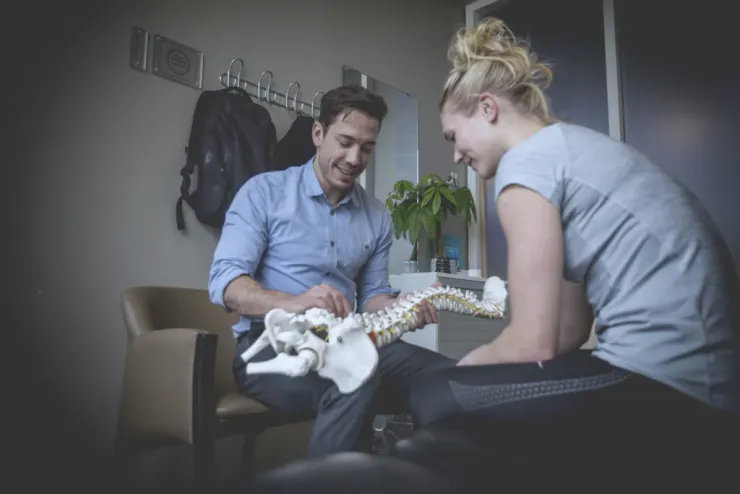
There are several kinds of hip problems and hip conditions. Hip complaints — or simply hip pain — are complaints of the hip, the hip joint or the pelvis: pain and stiffness in the hip or the groin, especially when standing up or climbing stairs, or a nagging pain that keeps you awake at night. The hip is a large joint that carries most of your body weight; in the hip joint the socket and the ball move smoothly in each other, and the cartilage between them can wear down. People often call that a worn hip; the medical name is hip osteoarthritis. Hip complaints often come from the joint itself, but the muscles and tendons around it can also become overused. Most hip complaints are harmless and well treatable, although some signals deserve medical assessment first.
You can visit Embody Health Chiropractie without a referral from your GP; your first visit costs €39. After a full intake and physical examination you know straight away whether chiropractic care fits your complaint. Most Dutch health insurers (partially) reimburse chiropractic care from the supplementary package, without using your deductible.
Together with our teams in Alphen aan den Rijn, Amersfoort, and Rotterdam, we have helped more than 2500 people with complaints over 12 years; on Google we average 4.9 out of 5.
“I was already being treated for hip/back complaints and asked whether something could also be done about my long-term carpal tunnel complaints. It was possible and serious, after 1 treatment (!!!) already so much…”Read the full review
“I was already being treated for hip/back complaints and asked whether something could also be done about my long-term carpal tunnel complaints. It was possible and serious, after 1 treatment (!!!) already so much improvement!! Truly remarkable and wonderful!”

Symptoms: where does the pain in the hip sit?
Hip complaints can show up as different kinds of pain. The nature and severity of the complaints, and where the pain sits — from pain in the groin region to pain on the outside of the hip — often tell us a lot about the cause. Do you recognise one or more of the following symptoms?
- pain in the hip or in the groin, for example when walking or climbing stairs
- stiffness of the hips when standing up from a chair or after sitting for a long time
- night-time pain that keeps you awake, or pain when turning over in bed
- pain on the outside of the hip, often with bursitis
- pain radiating to the back or the side of the upper leg
- trouble with ordinary movements such as putting on socks, or a hip that does not move along smoothly
- swelling, warmth or redness around the hip, or trouble loading the leg after a fall on the hip
Nagging pain that lingers
Many people describe their hip not as sharply painful but as nagging: a pain that stays in the background and gets worse with certain movements. That pattern often belongs to wear of the hip joint (hip osteoarthritis) or to overuse of the tendons around the hip. The start-up pain is typical: the first steps after getting up or after sitting for a long time hurt most, and after that it often eases a little. If your hip mainly feels stiff and movement slowly gets easier, that is a reason to have it assessed. A painful hip usually comes on gradually, and climbing stairs and standing for a long time make the complaints worse. Hip osteoarthritis is most common in older people, but younger people can have it too.
Pain on the outside of the hip
On the outside of the hip a point of bone sticks out: the place where the gluteal muscles and tendons come together. Pain right there is one of the most common hip complaints. Often the tendons of the gluteal muscles play the main role and the bursa between them is irritated. You notice it especially when lying on the affected side, when climbing stairs, when walking uphill, and when standing for a long time with your weight on one leg. The pain comes and goes, and can pull along the side of the upper leg. Overuse of the tendons around that point of bone often causes pain on the outside of the hip. If the pain gets worse during the day, that is a clue we weigh up.
Hip pain when lying down or sleeping
Do you wake from pain on the outside of the hip, or does turning over in bed hurt? That pattern often fits pressure on the tendons or the bursa on the outside of the hip. For many people, lying on the painful side makes it worse. What often helps: sleep on your other side with a pillow between your knees, so the hip stays in a calmer line. If the night-time pain continues or gets worse, mention it at your first visit; it is an important signal for our examination.
Pain at the attachment on the pelvis
Is your pain in exactly one spot, for example under the buttock at the ischial tuberosity? Then the complaint often sits at the attachment: the place where muscles and tendons attach to the pelvis. Those attachments can become irritated or overused, which gives a deep, nagging pain in exactly that spot. Standing up from a low chair and sitting for a long time often make it worse, while rest eases it temporarily. This pattern is usually harmless and responds well to targeted treatment and adjusted loading.
Pain radiating from the hip down the leg
Sometimes the pain does not stay in the hip but travels down the side of the upper leg, sometimes as far as the knee. That fits complaints from the hip joint or the tendons around it, which cause pain in a place further down. Complaints in the thigh and knee complaints can therefore come from the hip. It is important to know where the pain starts. Pain that runs from the lower back through the buttock into the leg, with tingling or numbness, belongs to a different group of complaints: that is nerve pain, and we look at it differently.
Hips and lower back belong together
Hips and lower back work together with every step you take. If movement in the hip gets stuck, the lower back takes over, and the other way round. People with hip pain therefore often have lower back complaints too, and joint pain in one place can cause complaints in another. During your first visit we look at that interplay, so that we do not only treat the place where it hurts.
Did you know most Dutch health insurers (partially) reimburse chiropractic care without using your deductible?
Check your coverageCauses of hip pain
What can cause a painful hip? Several factors usually play a role in how hip complaints develop. Complaints can start suddenly or build up slowly. Common causes are wear in the hip and overuse of tendons or of a bursa, such as bursitis:
- Wear (osteoarthritis): in wear of the hip the cartilage in the hip joint becomes thinner, so the joint becomes stiff and painful, especially after rest.
- Overuse: sitting for long periods, one-sided loading, intense sports, or a changed walking pattern can overuse the muscles, tendons, and bursae around the hip.
- Bursitis: an inflammation of the bursa on the outside of the hip often gives pain when lying on your side or when climbing stairs.
- The pelvis: the pelvis connects the spine to the hips; disturbed movement of the pelvis or the SI joint can put tension on the hips.
- Hip dysplasia: with a congenital abnormality of the socket, such as hip dysplasia, the joint is less stable. Later in life that can cause joint pain and wear.
- A fall or a bump: acute complaints after a fall on the hip can arise because the joint blocks; a hip fracture, visible deformity, or inability to load the leg first requires medical help.
- Pregnancy: around pregnancy the ligaments become more supple, so the pelvis and hips move more and complaints can arise.
What is the most common cause of hip pain?
Usually it is not one cause but a combination of wear, overuse and movement. That is exactly why we ask about your whole movement pattern during the first visit, and not only about the spot where it hurts.
Osteoarthritis in the hip
In osteoarthritis of the hip the cartilage in the hip joint gradually becomes thinner. That gives stiffness and pain, especially with the first movements after rest and when climbing stairs. Wear of the hip develops slowly and cannot be cured, but movement and targeted exercises keep the joint supple and reduce the pain. In many people with osteoarthritis that reduces the pain and keeps mobility for longer. You can read more on our page about osteoarthritis and joint wear.
Bursitis in the hip (trochanteric bursitis)
Bursitis in the hip sits on the outside, where the bursa lies between the tendons and the point of bone. Lying on the painful side, climbing stairs, and standing for a long time with your weight on one leg make it worse. The complaints resemble those of the tendons around the hip joint, and we tell the two apart during your first visit. Bursitis is common in people who stand on one leg a lot. Anti-inflammatory painkillers can help ease the pain temporarily; if you want to use them, discuss it with your GP.
First: rule out a broken hip and other serious causes
Every first visit at Embody Health begins with a careful screening of the signals that need medical assessment, as part of the physical examination. Most hip complaints are harmless and well treatable, and we always screen first for the few signals that need medical assessment: sudden severe pain with inability to load the leg, loss of control over your bladder or bowels, or fever combined with pain in a joint — we guide you through that. Pregnant? Then we consult your midwife or gynaecologist together with you on unusual complaints. Once those signals are ruled out, we investigate whether chiropractic care can support your hip complaints. We can help here, and we tell you honestly whether another care provider is the better first step.
Your chiropractor is a primary-contact practitioner — hip complaints like yours are what we assess daily, often before anyone else looks at them. That is exactly what we are trained for: we screen for the rare serious causes of hip pain, and most of the time the answer is good news. Most hip complaints are harmless and well treatable. Only 4 signals are worth reporting yourself:
- sudden severe pain in the pelvis or hip with inability to load the leg
- loss of control over your bladder or bowels
- fever combined with pain in a joint
- during pregnancy: blood loss, contractions, or less movement of your baby — contact your midwife or gynaecologist directly
These deserve attention the same day. Contact us — we have WhatsApp availability; our front desk will notify the chiropractor right away if it looks urgent, and we will assess your hip complaints and tell you honestly whether hospital care is needed; you need no referral and no detour. Not sure? Talk it through with your GP or with us — but we are here, and we screen it together with you.
Does it feel like bone pain? Have it assessed first
Many people say the pain sits on the bone. In the hip that feeling usually comes from the tendons and attachments lying right next to the bone, not from the bone itself. Even so, we hold to one rule: pain that breaks through at night without a clear cause, pain after a fall or a bump, and pain with fever first ask for medical assessment. Not because it is often something serious, but because it can be. We screen for this during your first visit and refer you directly if that is needed.
Treating hip pain at Embody Health
What is known from research? Systematic reviews of manual therapy and exercises for hip osteoarthritis show that this approach can reduce pain and improve the function of the hip. That matches what we see in practice: in many people with hip complaints, also chronic complaints, the stiffness decreases and they have less trouble walking and climbing stairs, so daily activities become easier again.
The treatment of hip complaints focuses on the interplay of the pelvis, the hip, and the lower back. During your first visit we examine the mobility of the hip and the hip joint, the tension in the muscles around the hip, and how the pelvis moves. With gentle, precise corrections we restore the movement of the joint and the surrounding muscles, tendons, and bursae, and we help optimise the movement of the hip. The aim is that walking and moving become smooth again and that the pain decreases. Which approach fits best, we discuss honestly during your first visit, and together we draw up a treatment plan.
Your first visit costs €39; a single follow-up consultation costs €65 and a consultation in a recovery package €55. Check what your health insurance covers and the prices.
Working together with physiotherapists
Hip and groin complaints often ask for more than one approach. We look at the mobility of the joint and the pelvis; physiotherapy works with strength, condition, and building up your loading. When exercise therapy fits alongside the treatment, we align it with your physiotherapist, so that you do not follow two separate tracks and mobility improves faster. We also consult your GP whenever that is needed.
What you can do yourself about hip complaints
Our most important practical tips: keep moving within the pain limit, because complete rest often makes the hip stiffer. Walking, cycling, and gentle stair climbing help preserve flexibility and keep the joint supple. Keeping moving is also the way to keep daily activities easier, and targeted exercises for the muscles around the hip make the hip stronger and help prevent complaints. Listen to your body: rest on days when the hip protests more and build up the loading gently afterwards. Do not wait too long: if the pain lasts longer than two weeks, or if pain complaints keep coming back, we are happy to look at it with you.
Do you often wake at night from your hip? Then change sides and put a pillow between your knees, so the hip stays in a calm line. If you sleep on a mattress that sags, a firmer mattress often makes the night calmer. If you notice the pain mainly flares up in the cold or after sitting still for a long time, a short walk can loosen the hip again.
Does the pain sit mainly on the outside of the hip? Then the page about hip bursitis goes deeper into that. If the pain travels down into the buttock or the groin instead, look at pain in the buttock or at pelvic complaints around pregnancy. For stiffness and wear in the joint itself there is the page about osteoarthritis, and for pain that shoots from the back into the leg you can read on at lower back pain. Want to know where your complaints come from? Book a first visit; then we look together at what fits your situation, or whether another care provider is the better first step.
Frequently Asked Questions
What does a pelvic and hip complaints treatment cost?
Your first visit costs €39. Follow-up consultations are €65 (single) or €55 per consult in a package; child consultations are €35. Most Dutch health insurers (partially) cover chiropractic care from the supplementary package.
Should I see a GP first after a fall on my hip?
With severe pain or if you cannot load your leg, it is wise to seek medical help first, for example to rule out a fracture. Once that has happened and you still have complaints, chiropractic care can help to address the remaining stiffness or block in the hip or pelvis. During the first visit we map the complaint carefully.
How many treatments do I need for hip complaints?
That differs per person and depends on the cause and how long the complaint has existed. After the first examination we make a personal treatment plan together, so you know exactly what to expect. Some people notice improvement after a few treatments, others need a little more time — we follow the progress and adjust the plan where needed.
Why does the outside of my hip hurt?
Pain on the outside of the hip usually sits around the point of bone where the gluteal muscles and tendons come together. Tension or irritation there gives pain when lying on your side, climbing stairs or standing for a long time, and the pain can pull along the side of the upper leg. During the first visit we examine which structure causes your complaint and which approach fits it.
Is hip pain at night something to worry about?
Night-time hip pain is common and usually fits pressure on the tendons or the bursa on the outside of the hip. Sleeping on your other side, with a pillow between your knees, makes the night calmer for many people. If the pain continues or gets worse, have it assessed.
Can bone pain in the hip be serious?
What people experience as bone pain usually does not sit in the bone itself, but in the tendons and attachments right next to it. Pain that breaks through at night without a clear cause, pain after a fall or a bump, or pain with fever first asks for medical assessment. We screen for this as standard during the first visit and refer you directly if that is needed.
What is pain at the attachment on the pelvis?
That is pain in the place where muscles and tendons attach to the pelvis, for example at the ischial tuberosity under the buttock. Overuse of those attachments gives a deep, nagging pain in exactly one spot, and it often gets worse from climbing stairs or sitting for a long time. It is usually well treatable with targeted care and adjusted loading.
What can I do myself about hip pain at night?
Change sides and put a pillow between your knees, so the hip stays in a calmer line. Keep moving during the day, within the pain limit. If the night-time pain continues, mention it at your first visit.
Why does my hip hurt when I stand up?
The first steps after getting out of bed or out of a chair hurt most for many people with hip pain. That is because a joint that has just been still feels stiffer and only loosens once it moves again. If the pain eases after a few steps, that fits wear or overuse; if the pain stays with every step, we look further during the first visit.
My hip clicks or creaks — is that a problem?
A hip that clicks or creaks is common, also in people without pain, and on its own is no reason for concern. Do mention it during the first visit: we look at where the sound comes from, whether tension or a movement restriction plays a role, and whether there is something we can treat.
Is nagging pain in my hip a sign of osteoarthritis?
Nagging pain can fit osteoarthritis, but also overuse of the tendons around the hip, and the complaints resemble each other. What helps us tell them apart: where exactly the pain sits, whether it gets worse from lying on your side or rather from climbing stairs, and how long the complaint has existed. When in doubt we look further than the hip alone during the first visit.
How long may hip complaints last before I seek help?
Hip complaints that have been present for less than six weeks we first look at calmly together with you. If the pain lasts longer than three months, or keeps coming back, we look more broadly at the whole movement chain of pelvis, hip and lower back, and we align with your GP or physiotherapist.
Sources
- NHS: Hip pain — causes, self-care and when to get help (accessed 05-11-2026)
- NHS: Broken hip. With a broken hip you have pain in the hip and you can no longer walk (accessed 05-11-2026).
- NHS: Bursitis. Bursitis is when the fluid-filled sacs (bursa) that cushion the joints have become painful and swollen (accessed 05-11-2026).
- Systematic review: manual therapy and therapeutic exercise for hip osteoarthritis (2013) — less pain and better function
- Systematic review: exercise and manual therapy for pain from hip osteoarthritis — reduction of pain
- Proximal hamstring tendinopathy: clinical aspects of assessment and management (2016). Deep buttock pain at the hamstring origin, managed along the current principles for painful tendinopathy.
- The management of greater trochanteric pain syndrome: systematic review (2016). A common cause of pain on the outside of the hip; most cases respond to conservative treatment.
- Hip pain in adults: evaluation and differential diagnosis (2021). Pain on the outside of the hip is most commonly caused by greater trochanteric pain syndrome: gluteus medius tendinopathy, bursitis and iliotibial band friction.
Next time you search, get an answer this clear again — add Embody to your preferred sources.