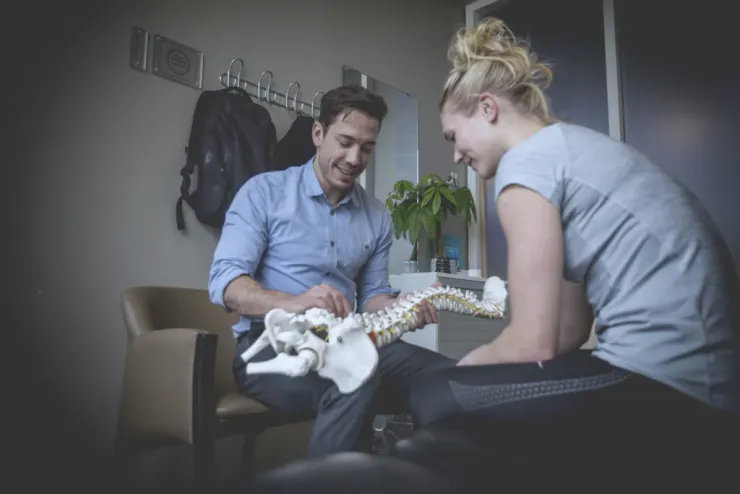
Chiropractor vs Physiotherapist: Which Should You See?
2 professions treat the same stiff back from different angles: the physiotherapist rebuilds movement and strength, the chiropractor treats joints by hand.

Physiotherapists are BIG-registered. Chiropractors aren’t; they use separate professional registers, and insurance treats the two differently. Does that make physiotherapy the “real medical” choice and chiropractic the alternative? Not quite. Suppose your back hurts now. Do you need someone to help you rebuild movement and strength, or someone to examine the stiff area and treat it by hand?
The short answer
2 professions treat the same stiff, painful back from different angles: the physiotherapist rebuilds movement, strength and day-to-day function, while the chiropractor spends more of the visit on examining the spine and treating joints by hand. Both work with muscles and joints. The two professions have a lot of overlap. In both physiotherapy and chiropractic, you may receive exercise or manual care: a physiotherapist may mobilise a joint, and a chiropractor may prescribe exercises.
For a stiff, painful back or neck, I would usually start with a registered chiropractor. After an operation or injury, or when the main job is returning to sport, physiotherapy often makes more sense. You may also use both at different stages of recovery.
Chiropractors vs physiotherapists: similarities and differences
| Question | Chiropractor | General physiotherapist |
|---|---|---|
| Appointment emphasis | Examine the spine, joints and muscles; precise hands-on treatment, with exercise where useful | Check movement and everyday tasks; use exercise to rebuild function, with hands-on care where useful |
| Clinical philosophy | The nervous system controls and coordinates the body. Restricted movement can contribute to pain and reduced function. Chiropractic focuses on how spinal movement affects nerves, joints, muscles and overall function | Build strength and movement step by step, so the patient can do more independently |
| Typical methods (Relative emphasis, not exclusive techniques) | Spinal adjustments, joint mobilisation, myofascial release and exercise. (Some also use dry needling, acupuncture, taping or other modalities.) | Exercise, movement practice and education; may include massage, taping, dry needling, ultrasound or shockwave |
| Qualification | No Dutch chiropractic programme. Training averages about 5.5 years; 7–8 years in Canada, with at least 3 university years required before admission. Four of the 20 countries compared include a doctoral qualification. See the full comparison. Dutch registers: SNRC or SCN. | 3–4-year, 240-ECTS university-of-applied-sciences bachelor. Direct entry after secondary school; accelerated routes may require a pre-university secondary diploma or a previous bachelor's degree. Mandatory BIG registration |
| Often best suited to | Back, neck or joint pain; hands-on assessment | Post-operative care, sports injuries and rehabilitation |
| Referral | No referral required | Usually no referral; some insured care requires one |
| Insurance | Supplementary insurance or self-paid; never basic insurance | Usually supplementary insurance or self-paid; basic insurance only for specific conditions |
The main difference between the two is emphasis. General physiotherapy usually gives exercise and rehabilitation a larger role. Chiropractic training concentrates more heavily on examining the spine and treating joints by hand. The professions overlap, so do not expect every appointment to follow the same formula.
Here, physiotherapy means general physiotherapy. Manual therapists have postgraduate training, so we cover them in a separate comparison.
The title alone cannot tell you what will happen in the treatment room. Physiotherapists and chiropractors both work with musculoskeletal pain, and both may help you move and function more easily. Hands-on treatment cannot repair every cartilage, ligament or tendon problem, though. Ask how often the practitioner sees your complaint and what the treatment plan will involve.
Physiotherapy: exercise, massage and rehabilitation
Physiotherapists treat a wide range of conditions, from back and neck pain to a repetitive strain injury. After an operation or sports injury, you may gradually load a tendon or ligament, rebuild strength and practise the movements your work or sport requires. Massage and other soft tissue work may relieve pain for a while. Exercise is usually what helps you return to full function.
Physiotherapy has a broad scope of practice. The KNGF lists general physiotherapy and twelve specialist profiles. Choose someone who regularly treats your complaint.
What does a chiropractor do?
During the first visit, a chiropractor examines your complaint and checks whether chiropractic care is appropriate. Chiropractors use their hands to adjust the joints of your spine or limbs when movement is restricted. They may also use mobilisation techniques, treat soft tissue problems and give you exercises. Some specific manipulation techniques make a cracking sound. That sound is not the goal and does not tell you whether treatment worked.
Manipulation can increase movement in a stiff or painful joint. Choose an outcome you can notice, such as turning your head, bending, walking or sleeping more comfortably. If that does not improve, change the plan.
Mobilisation may help a stiff, painful joint. It is a poor answer to obvious swelling in joints, significant ligament and tendon injuries, or symptoms that keep worsening. Those problems may need physiotherapy or medical assessment. Manipulation should have a clear purpose: to reduce pain or help restore normal body movement.
What are the disadvantages of chiropractic care?
The disadvantages of chiropractic therapy are mostly small and short-lived, but they are real. Local soreness, stiffness, tiredness or a mild headache later that day is common and usually settles on its own. Serious complications are rare, but trials are too small to measure very rare events, and a 2023 review found that reporting of side effects in spinal-manipulation trials was incomplete. Two practical disadvantages matter more day to day. Chiropractic sits outside basic insurance and outside the BIG register, so you pay from supplementary cover and must check the practitioner's degree and register yourself. And a plan built on adjustments alone is a weak plan: guidelines put manual therapy inside a package that includes exercise, because hands-on treatment works best alongside movement you keep doing.
For back pain, neck pain or sciatica with restricted movement, spinal examination and hands-on joint treatment are not add-ons in chiropractic training. They are central to the course and to a chiropractor's everyday work. Training still varies, so check that your chiropractor completed an accredited programme and is registered.
Quick way to choose
- Want someone to examine a stiff or painful back, neck or joint by hand? Start with a registered chiropractor.
- Need to regain strength or fitness after an operation or injury? A physiotherapist is often the better fit.
- Finding exercise too painful now, but want to become stronger afterwards? You may benefit from both.
Education and training: the difference between a physiotherapist and chiropractor
Dutch physiotherapists usually complete a four-year, 240-ECTS university-of-applied-sciences bachelor. Accelerated three-year routes covering the same 240 ECTS also exist; some require a pre-university secondary diploma or a previous bachelor's degree. “Physiotherapist” is a protected Article 3 title: the practitioner needs the qualification and BIG registration and falls under disciplinary law.
There is no entry-level chiropractic programme in the Netherlands, so chiropractors train abroad. The UK offers a four-year MChiro and Denmark a five-year BSc and MSc. CMCC in Canada requires university study before its four-year DC and describes the usual bachelor's-plus-DC route as eight years. Dr. Malone completed the full eight-year BSc and DC path. Our education comparison shows the range across 20 countries. The independent SNRC checks education, association membership and continuing quality requirements; it is not part of the BIG register.
On regulation, physiotherapy has the clearer position in the Netherlands. Its title is protected and BIG registration is mandatory. Chiropractors are not in the BIG register, so check their degree and professional register yourself. Dr. Stephen Malone completed a Canadian BSc in Kinesiology before his four-year Doctor of Chiropractic at CMCC; other chiropractors may have trained differently.
Does chiropractic count as physiotherapy?
No. Chiropractic and physiotherapy are separate professions, with separate training routes and separate registers. A chiropractor is not a physiotherapist and does not hold the protected physiotherapist title. The reverse also holds: a physiotherapist who manipulates joints is still a physiotherapist, usually with postgraduate manual-therapy training. That separation shows up in the paperwork. The chronic-list rules that let basic insurance pay for physiotherapy from session 21 do not apply to chiropractic care, and each profession invoices under its own tariffs.
Treatment by a chiropractor and physiotherapist: what the evidence says
Studies usually compare treatments rather than job titles. A Cochrane review found that exercise can probably decrease pain in people with chronic low-back pain. Its 2026 review of spinal manipulation found generally small effects. Certainty was often low when researchers compared manipulation with sham treatment, no treatment or other conservative care.
Guidelines do not tell everyone to choose the same profession. NICE recommends exercise for low-back pain and says manual therapy belongs in a package that includes exercise. WHO also recommends care tailored to the person. Hands-on treatment may help when pain and stiffness stop you moving. Gradual exercise matters more when lost strength or fitness is the main problem.
Should I see a physio or chiropractor for a trapped nerve?
First, check what the pain is doing. Nerve pain tends to burn, shoot or tingle and travels along a nerve path; muscle pain is dull and stays in one place. When a nerve is compressed from the back or neck, a chiropractor examines where the pressure comes from. A 2021 randomised trial in The American Journal of Medicine found that people with persistent radiating nerve pain improved more when spinal manipulation was added to their treatment, and NICE lists spinal manipulation as an option for low back pain with or without sciatica, combined with exercise and myofascial release. Physiotherapy fits better when weakness, lost fitness or recovery after an operation is the main problem. With progressive weakness, numbness around the saddle area or bladder problems, see your GP first.
Which should you choose?
Start with what is stopping you right now:
- Your back, neck or another joint feels stiff and painful: a registered chiropractor can examine it and discuss hands-on treatment.
- You are recovering from surgery, a fracture or a long period of inactivity: see a physiotherapist with relevant rehabilitation experience.
- Pain is making exercise difficult: chiropractic treatment may help you start moving; physiotherapy can help you become stronger afterwards.
- Your symptoms are unexplained or getting worse: ask your GP or medical team to assess them.
Ask three questions: What is causing my difficulty? How will we know treatment is working? What will we do if it is not? Expect clear answers.
Is anything better than a physiotherapist?
Nothing is automatically better, and the useful question is fit rather than rank. For a back or neck that is stiff and painful now, a registered chiropractor's examination and hands-on treatment may get you moving sooner. For rehabilitation after an operation, a physiotherapist with that experience is the stronger choice. For a joint that is swollen, hot or unstable, or symptoms that keep getting worse, your GP comes before either. A practitioner who says their own profession is always the answer has stopped examining the problem.
Is it better to see a chiropractor or an osteopath?
Neither is better in the abstract; what differs is the training behind the hands. A chiropractor holds an accredited DC or MSc in Chiropractic, works mainly on the spine and joints, and registers with the SNRC. A Dutch osteopath usually adds about five years of part-time training to a healthcare degree, most often physiotherapy, and treats the body as one connected system with gentle repeated mobilisation, soft-tissue work and stretching. “Osteopath” is not a title protected by law here, so check the NOF or NRO register before you book. Both are reimbursed through supplementary insurance, often from the same yearly budget, and neither needs a referral. Our chiropractor and osteopath comparison puts the two side by side.
Put all three together and the split is easier to hold: the physiotherapist rebuilds strength and function, the chiropractor treats the stiff spinal segment by hand, and the osteopath works through the whole body with gentler, repeated movement.
Why I became a chiropractor
After a snowboarding injury left me unable to walk, my chiropractor treated me, explained what he saw in plain language and took my fear seriously. I wanted to offer others that same practical help and personal attention. Kinesiology taught me movement science; chiropractic taught me to apply it with my hands. Read the full story on my profile.
I do not think every problem needs a chiropractor. If you need structured rehabilitation after an operation, I will say so. During your first visit, we examine the problem and decide together what should happen next.
Referral and health-insurance differences
Neither profession normally requires a GP referral. Physiotherapy has been directly accessible since 1 January 2006, and chiropractors also accept direct bookings. If you need medical care instead, the practitioner should explain why.
Basic insurance pays for adult physiotherapy only in defined situations. For many conditions on the chronic list, you pay for the first 20 sessions and basic insurance starts paying from session 21. Some conditions have different rules. The deductible applies when treatment is paid from basic insurance.
Chiropractic is outside basic insurance. Supplementary cover may reimburse a registered practitioner without using the statutory deductible. Check your policy on our insurance page.
“Not being familiar with chiropractic care, I found Embody Health through a search. If you are looking for a chiropractor, look no further. I had shoulder and neck problems for a year to a year and a half. Now after 12…”Read the full review
“Not being familiar with chiropractic care, I found Embody Health through a search. If you are looking for a chiropractor, look no further. I had shoulder and neck problems for a year to a year and a half. Now after 12 treatments I feel so much better that my pain is no longer a daily grind. Dr. Stephen Malone is a very skilled chiropractor, friendly, and takes the time for you. This treatment helped me a lot and I would recommend Dr. Stephen to everyone.”

Not sure where to start? We can examine the problem and talk through your options. Your first Embody visit costs €39.
What happens at the first visitFrequently Asked Questions
What is the main difference between a chiropractor and physiotherapist?
Physiotherapy usually centres on restoring strength, movement and day-to-day function. Chiropractic training gives more attention to examining and treating the spine and joints by hand. Both may use exercise or manual techniques.
Is it better to see a chiropractor or physiotherapist for back pain?
For back or neck pain that feels stiff, a registered chiropractor is a sensible place to start. Physiotherapy often fits better after surgery or when rebuilding strength is the main goal. Some people benefit from both.
Can a physiotherapist do chiropractic adjustments?
A physiotherapist with postgraduate manual-therapy training may use joint manipulation, but not every physiotherapist offers it. Ask what training your practitioner has completed.
Do I need a GP referral for physiotherapy or chiropractic in the Netherlands?
Usually not. Physiotherapy has been directly accessible in the Netherlands since 2006, and chiropractors also accept direct bookings. The practitioner should refer you if medical assessment is safer.
Is physiotherapy covered by Dutch basic health insurance?
Sometimes. For many conditions on the chronic list, adults pay for the first 20 sessions and basic insurance starts at session 21. The deductible applies. Chiropractic reimbursement comes only from supplementary insurance and depends on your policy.
Can chiropractic and physiotherapy be combined?
Yes. Hands-on treatment may make exercise easier; physiotherapy can then build strength and confidence. NICE recommends manual therapy for low back pain only as part of a package that includes exercise.
Most back, neck and joint complaints are harmless and well treatable. Tell us straight away if you notice one of these four signs:
- Sudden or progressive loss of strength in an arm or leg
- Numbness around the saddle area, or problems urinating or with bowel control
- Pain with fever, unexplained weight loss, or night pain that is not relieved by painkillers
- New double vision, difficulty speaking, or trouble swallowing
Contact us the same day so we can help you decide whether medical assessment is needed. Not sure? Talk it through with your GP or with us.
Sources
Education and registers
- BIG-register: physiotherapist is an Article 3 profession with a protected title, mandatory registration and disciplinary law
- HAN University of Applied Sciences: Dutch physiotherapy bachelor, 240 credits over four years
- Hanze University of Applied Sciences: accelerated three-year, 240-ECTS physiotherapy route for students with a pre-university secondary diploma or a previous bachelor's degree
- KNGF: general physiotherapy scope and twelve separate specialist profiles
- World Federation of Chiropractic: chiropractic focuses on musculoskeletal disorders, particularly the spine, and their relationship with the nervous system
- European Council on Chiropractic Education: accredited programmes include master's-level chiropractic qualifications across Europe
- Canadian Memorial Chiropractic College: at least three years of university study before its four-year Doctor of Chiropractic programme
- CMCC pathways: the usual combined bachelor's and Doctor of Chiropractic route takes eight years
- SNRC: independent register for chiropractors affiliated with DCF, NCA or CCA
- SCN: independent quality register used by NCA chiropractors
Access and reimbursement
- KNGF profession column: Direct Access Physiotherapy since 1 January 2006
- Dutch government: indication-specific physiotherapy coverage under basic insurance
- Zorginstituut Nederland: coverage limits, first 20 sessions and deductible
- Embody Health insurance guide: current supplementary chiropractic reimbursement by insurer
Treatment evidence
- NICE NG59: exercise and manual therapy within a treatment package for low back pain
- World Health Organization: person-centred, integrated care for chronic primary low back pain
- Cochrane: exercise therapy for chronic low back pain
- Cochrane 2026: spinal manipulative therapy for chronic low back pain
Next time you search, get an answer this clear again — add Embody to your preferred sources.