
Hip Bursitis: Causes, Symptoms and Exercises That Help
Hip bursitis (trochanteric bursitis) from overload? Read the symptoms and what you can do yourself with exercises and physiotherapy.

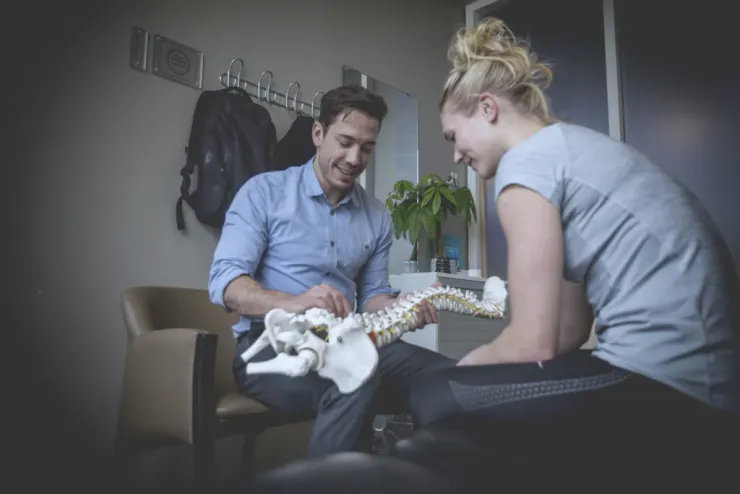
What is hip bursitis (trochanteric bursitis)?
A bursa is a small fluid-filled sac that sits between a bone and the tendon running over it. The sac acts as a cushion, so the tendon can glide smoothly without rubbing against the bone. When a bursa in the hip becomes irritated or inflamed, we call it hip bursitis. The inflammation brings pain, usually on the outside of the hip around the bony point at the top of the thigh. Doctors group this picture under greater trochanteric pain syndrome, or trochanteric bursitis. A bursa can become inflamed in any joint, but the shoulder, hip, elbow and knee are the ones affected most often.
You come to Embody Health Chiropractie without a referral; your first visit costs €39. During that intake and examination we work out whether chiropractic care can help your complaint, and you hear that straight away. Most Dutch health insurers (partially) reimburse chiropractic care from the supplementary package, without touching your deductible.
Our three clinics in Alphen aan den Rijn, Amersfoort and Rotterdam have seen more than 2500 people with back, neck and joint complaints over the past twelve years. Patients rate us on average 4.9 out of 5 stars on Google.
“I was already being treated for hip/back complaints and asked whether something could also be done about my long-term carpal tunnel complaints. It was possible and serious, after 1 treatment (!!!) already so much…”Read the full review
“I was already being treated for hip/back complaints and asked whether something could also be done about my long-term carpal tunnel complaints. It was possible and serious, after 1 treatment (!!!) already so much improvement!! Truly remarkable and wonderful!”

Symptoms: pain on the outside of the hip
The symptoms of hip bursitis sit almost always on the outside of the hip, around the bony point you can feel yourself. Typical is a dull, aching pain rather than a sharp one, and the area may be tender or warmer than the skin around it. The pain comes and goes: it flares with certain movements and settles again. Sometimes it travels down the side of the thigh as far as the knee, and pain in the buttock or lower back also occurs. Lying on the painful side, walking uphill and getting up after sitting for a long time often make it worse. Do you recognise one of these patterns?
- pain on the outside of the hip, around the bony point of the thigh
- pain when you lie on the painful side, for example when you sleep on your side
- pain when walking, climbing stairs or after a long walk
- pain when cycling, running or playing sport
- pain when bending, or when you press on the hip with your hand
- a tingling or prickling feeling on the side of the thigh
Outside of the hip, not deep in the joint
The spot often tells the story. With hip bursitis you feel it on the outside, just under the skin at the bony point; you can point to it with one finger. Pain deep in the groin or inside the hip joint more often belongs to the joint itself. Because the two sit close together and can feed each other, we examine both during your first visit.
Causes: overload and other factors
What inflames a bursa in the hip is usually a mix of repeated friction and pressure on exactly that spot. In practice we mainly see these causes:
- Overload and repeated movement: running, lots of stairs or a long walk put friction on the same spot again and again.
- Pressure from outside: prolonged leaning, kneeling or lifting can irritate the bursa.
- Sleeping on your side: sleeping on the same side puts pressure on the bursa night after night.
- A difference in leg length: when you stand unevenly, the longer leg takes more strain on the outside of the hip.
- Weak muscles around the hip: when the gluteal muscles support the pelvis less well, the tendons at the bony point take more pull.
- Osteoarthritis or a previous operation: wear in the hip joint, inflammation in the joint or hip surgery in the past make the complaint more likely.
- Being overweight: extra weight puts more pressure on the joints and the bursa.
Diagnosis: hip bursitis or tendon problems?
Pain on the outside of the hip most commonly comes as part of greater trochanteric pain syndrome. That umbrella holds bursitis, but also tendon problems or a tear in the gluteus medius tendon, and friction of the iliotibial band along the outside of the leg. Because these causes produce the same symptoms, the difference is not always sharp at the start. During your first visit we perform a physical examination: we feel exactly where it hurts, test how the hip moves and watch how you walk and stand. Imaging such as an ultrasound is sometimes needed, and when another cause is suspected we refer you to your GP or an orthopaedic specialist.
First: rule out serious signals
At Embody Health a first consultation always opens by screening the signals that need medical assessment. Most complaints on the outside of the hip are harmless and treatable, and those few signals we look at first.
Pain around the hip is almost always in the muscles, the tendons or the joint — exactly what we assess every day. The rare serious causes are what we do not want to miss, so we rule those out first. Four signals deserve attention the same day:
- sudden severe pain in the hip or pelvis with an inability to bear weight on the leg
- loss of control over your bladder or bowels
- fever combined with pain, heat and swelling in a joint — that can point to an infection
- after an injection in the hip: a temperature of 38°C or more, feeling ill, a warm spot at the injection site, or more pain two days after the injection
If you recognise any of these signals, call or message us the same day — our front desk alerts the chiropractor right away. Not sure? Talk it through with your GP or with us.
Did you know most Dutch health insurers (partially) reimburse chiropractic care without touching your deductible?
Check your coverTreatment: advice, exercises and an injection
What does research show? Complaints around the bony point on the outside of the hip respond well in most people to a conservative approach: adjusting the load, targeted exercises and manual therapy. Only a small group keeps complaints that ask for something else. That matches what we see in practice. During your first visit we examine the mobility of the hip, the tension in the gluteal muscles and the position of the pelvis. With gentle, precise corrections we work on the movement of the joint and of the muscles and tendons around it. The goal is that walking, stairs and sleep become smoother again.
When the pain is stubborn, your GP can give an injection of corticosteroids into the bursa. Such an injection often reduces pain for six to twelve weeks, but afterwards the complaints can return and in some people the injection does not help at all. Research shows that a programme of education and exercises does better over the longer term than an injection alone. If the bursa is infected, no injection is given; antibiotics are then the treatment. Painkillers such as paracetamol can ease the pain, and anti-inflammatory painkillers work for a short period, but neither tackles the cause.
Hip complaints often ask for more than one approach. Our part is the mobility of the joint and the pelvis; physiotherapy (physical therapy) brings in strength, condition and a gradual build-up of load. Where exercise therapy fits alongside our treatment, we keep that in step with your physiotherapist, so you follow one line rather than two separate tracks.
Your first visit costs €39; a single follow-up treatment costs €65 and a consult in a recovery package €55. See what your health insurer covers and the fees.
What you can do yourself about hip bursitis
Keep moving, but avoid what clearly makes the pain worse. Walking, swimming and cycling keep the muscles around the hip supple; complete rest usually makes the hip stiffer and the muscles weaker. Do not push through: skip sports that provoke the complaint, such as skiing or horse riding, and do not make long walks if they drive the pain up. Do not lie on the painful side of your hip; if you like sleeping on your side, choose the other one or put a cushion between your knees. Rest and ice can help bring down pain and swelling, and a cushion under your knees helps when you kneel. Regular short breaks in a different position stop the same spot taking pressure all day. If one leg is shorter than the other, an insole or heel raise can reduce the uneven stand. If you are overweight, losing weight can lower the pressure on the hip.
Chronic complaints: what if it persists?
Sometimes the pain lasts longer or keeps returning; then we speak of chronic complaints. Research shows that more body fat and poorer sleep are associated with more severe greater trochanteric pain syndrome. That does not mean they cause it, but it is a reason to look at weight and sleep as well. Exercising on your own helps, and guidance is often needed to build the load up in the right way.
Do the complaints persist? Read more about hip complaints and hip pain or pain in the buttock. Make an appointment for a first visit; together we will see what suits your situation and whether someone else is the better first step.
Frequently Asked Questions
What does a hip bursitis treatment cost?
Your first visit costs €39. Follow-up consultations are €65 (single) or €55 per consult in a package; child consultations are €35. Most Dutch health insurers (partially) cover chiropractic care from the supplementary package.
What is hip bursitis?
A bursa is a small fluid-filled sac between a bone and a tendon that works as a cushion, so the tendon can move smoothly. When that sac in the hip becomes irritated or inflamed, it causes pain on the outside of the hip around the bony point. Doctors call this picture greater trochanteric pain syndrome or trochanteric bursitis.
How long does hip bursitis last?
That differs per person. For many people the complaints settle within a few weeks to a few months once loading is built up calmly. If the pain lasts longer or keeps coming back, we look during your first visit at what keeps it going and what suits it.
What can I do about hip bursitis?
Keep moving within a pain-free range and avoid what clearly makes the pain worse. Do not lie on the painful side of your hip, and break up long periods of sitting with short walks. Exercises that strengthen the muscles around the hip help, and for persistent complaints your GP can consider a corticosteroid injection.
Is hip bursitis dangerous?
Usually not: it is a painful but harmless complaint that responds well to treatment. There is one exception to watch for. If the bursa becomes infected, it causes fever with a hot, swollen area. That needs medical assessment the same day, and we screen for it during your first visit.
Do I need to see a GP first for hip bursitis?
No, usually you do not: you can come to us without a referral. A few signals do need medical assessment first, such as sudden severe pain where you cannot put weight on the leg, loss of control over your bladder or bowels, or fever with pain, heat and swelling in a joint. We screen for those during your first visit and refer you straight on when that is needed.
Which exercises help with hip bursitis?
Exercises that strengthen the gluteal muscles and the muscles around the pelvis, so the hip joint has less loose movement to absorb. Think of lifting the leg slowly, pelvic tilts and light resistance work, built up within a pain limit you set yourself. A physiotherapist or chiropractor can tailor the exercises to your situation.
Can hip bursitis come back?
Yes, it can. If the cause remains, for example a lot of stair climbing, sleeping on the same side or a difference in leg length, the complaint can flare up again. That is why we look not only at the painful spot, but also at posture, loading and the movement of the hip and pelvis.
Sources
- NHS: Bursitis. What bursitis is, which joints it most often affects, how to treat it at home, and when to see a GP (accessed 05-11-2026).
- NHS: Hip pain. Causes and advice for pain around the hip, including pain that is worse when lying on the affected side (accessed 05-11-2026).
- Hip pain in adults: evaluation and differential diagnosis (2021) — lateral hip pain is most commonly caused by greater trochanteric pain syndrome, which includes gluteus medius tendinopathy, bursitis and iliotibial band friction (accessed 05-11-2026).
- The management of greater trochanteric pain syndrome: systematic review (2016) — most cases respond to conservative treatment; only a few refractory cases need more (accessed 05-11-2026).
- Education plus exercise versus corticosteroid injection for gluteal tendinopathy (BMJ 2018) — education and exercise gave a better longer-term outcome than a corticosteroid injection (accessed 05-11-2026).
- Increased adiposity and impaired sleep are associated with severity of greater trochanteric pain syndrome (2025) — more body fat and poorer sleep are associated with more severe complaints (accessed 05-11-2026).
Next time you search, get an answer this clear again — add Embody to your preferred sources.