Groin Pain: Not Always a Pulled Muscle or Hip Flexor
Groin pain can appear during exercise, walking or even at rest. Discover what might be causing it and when it's time to get it checked.

Groin pain and pain in the groin: rarely one fixed spot
Groin pain is pain in the groin area: the region between your abdomen and your thigh, on the inside of the leg. The complaint rarely comes from one fixed spot. Researchers therefore group groin pain by structure: pain around the adductors (the muscles on the inside of the leg), around the iliopsoas (the large hip flexor), around the inguinal canal, around the pubic bone, and pain that comes from the hip joint. Anything left over falls into a group of other causes. That grouping says one thing above all: where you feel the pain does not yet tell us which structure is causing it.
You come to Embody Health Chiropractie without a referral; your first visit costs €39. During that intake and examination you hear straight away whether chiropractic care fits your complaint. Most Dutch health insurers (partially) reimburse chiropractic care from the supplementary package, without touching your deductible.
“I was already being treated for hip/back complaints and asked whether something could also be done about my long-term carpal tunnel complaints. It was possible and serious, after 1 treatment (!!!) already so much…”Read the full review
“I was already being treated for hip/back complaints and asked whether something could also be done about my long-term carpal tunnel complaints. It was possible and serious, after 1 treatment (!!!) already so much improvement!! Truly remarkable and wonderful!”

Symptoms: where pain in the groin sits and what you notice
The most common form of groin pain is a strain of the muscles on the inside of the thigh, sometimes with the lower abdomen involved. You get it mainly in sports where you twist, turn and kick, such as football, or in any sport with quick changes in direction. Groin strains are common in exactly those sports. The adductor longus, one of the muscles on the inside of the thigh, is involved most often. Pressing on the spot often tells you which structure is taking part: with a strain you feel exactly where it hurts.
What do you notice with a groin injury?
- pain on the inside of the thigh, in the groin area
- pain when you squeeze your knees together
- pain when you bend your knee
- some minor swelling or bruising
- discomfort when coughing or sneezing, when the lower abdominal muscles are involved
Causes of groin pain: often more than one at once
In sports medicine there is often more than one cause. In athletes with hip and groin pain it regularly turns out that several structures are involved at once: the groin muscles, an overloaded tendon and an irritated joint. If you look only at the painful spot, you miss part of the story. That is why we look at the whole chain of pelvis, hip and thigh, and at the way you move.
Pain that comes from the hip itself is regularly missed in chronic groin complaints. A different shape of the hip joint (hip impingement) or a labral tear (a tear in the labrum, the cartilage rim around the hip socket) can cause sharp pain in the groin during certain hip movements, in exactly the same place as a muscle strain. In chronic pain this is easy to overlook.
From the hip, or from the muscles?
Deep in the groin, at the front of the hip, with a hip that moves less freely, more often belongs to the joint. On the inside of the thigh, with pain on squeezing, more often belongs to the muscles and tendons. Because the two can feed each other, we always examine both during your first visit. Sometimes groin pain starts suddenly after one movement; sometimes it creeps in and stays as a nagging pain.
Inguinal hernia: a cause that never goes away on its own
A hernia is a cause we always weigh up. With a hernia, part of an internal organ, such as your bowel, pushes through a gap or weak area in the muscle that keeps your organs in place. Most hernias develop in the abdomen or the groin. You usually see a bulge, which gets bigger when you cough, sneeze or strain and smaller when you lie down. In men the bulge can move down towards the scrotum, around the testicle. The bulge can hurt or give a sharp or burning feeling, but it does not have to: some people only notice a dragging feeling, or no pain at all. Unlike a muscle strain, a hernia never goes away on its own. The treatment is surgery, and when that is needed depends on your complaints.
Is it serious? Four signals we rule out first
Every first consultation at Embody Health starts by going through the signals that need medical assessment. By far the most groin pain is harmless and treatable. Those few exceptions are exactly what we do not want to overlook.
Pain in the groin is almost always in the muscles, the tendons or the joint — exactly what we assess every day. The few causes that can be serious are the ones we do not want to miss, so we rule them out first. Four signals deserve attention the same day:
- sudden severe pain in the groin with an inability to bear weight on the leg
- a bulge in the groin that you can no longer push back, certainly together with severe pain
- a hernia that hurts more and more, becomes harder to push back, or moves down towards the scrotum
- loss of control over your bladder or bowels
If any of these signals look familiar, call or message us that same day. Our front desk alerts the chiropractor straight away. Not sure? Talk it through with your GP or with us.
Did you know most Dutch health insurers (partially) reimburse chiropractic care without touching your deductible?
Check your coverExamination and diagnosis: how do we find the cause?
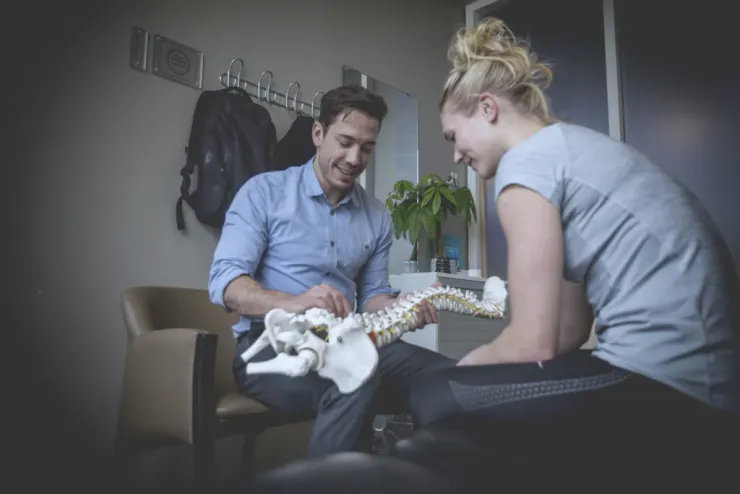
During your first visit we take a medical history: we ask where the pain started, which movements provoke it and how the complaints developed over the following days. Then we feel exactly where the groin or hip area is tender and test how the joint and the pelvis move. We ask you to squeeze your knees together, bend your knee and stand on one leg. If the hip moves less freely than expected, we look at the joint and the muscles around it separately. An ultrasound or other imaging is sometimes needed to rule out a hernia or a joint problem; we then refer you to your GP or a specialist.
Treating groin pain: what does the research say?
What does research show? Researchers found that a conservative approach to iliopsoas-related groin pain achieved success rates between 77 and 100 per cent in people without previous hip surgery. That matches what we see in practice. In our treatment we look at the mobility of the hip joint and the pelvis, at the tension in the muscles on the inside of the thigh, and at the way you stand and walk, and we set out a treatment plan around adjusting the load and strengthening exercises, with manual therapy where it is needed. With gentle, precise corrections we work on the movement of the joint and of the muscles around it, so that stairs, sport and daily activities become smoother again. The aim is a return to normal physical activity.
Groin complaints often ask for more than one approach. We work on how the joint and the pelvis move, while physical therapy adds strength, condition and a gradual build-up of load. When exercise therapy runs alongside our treatment, we align it with your physical therapist, so you are not following two separate tracks.
Your first visit costs €39; a single follow-up treatment costs €65 and a consult in a recovery package €55. See what your health insurer covers and the fees.
What you can do yourself for groin pain
In the first 48 hours after a strain, rest, ice and compression help. Keep the groin calm and avoid what clearly makes the pain worse. Apply an ice pack for 15 to 20 minutes, wrapped in a damp towel so it does not touch your skin directly. That gives pain relief in the first days. If the pain improves after that, you can start gentle exercises and build the load up: three sets of ten repetitions, building up to three sets of twenty, with one to two minutes of rest in between, around four times a week. If the pain clearly increases as you exercise, stop and have it assessed. How long it takes differs: minor strains settle in weeks, severe ones can take months, but with physiotherapy most people return to their previous level within six months. Build your return to sport up step by step, with preventing groin pain in mind.
Want to read more? See the page on hip complaints and hip pain, pain in the buttock or pelvic complaints. Book a first visit. Together we will look at what suits your situation and what the best route is for you.
Frequently Asked Questions
What does a groin pain treatment cost?
Your first visit costs €39. Follow-up consultations are €65 (single) or €55 per consult in a package; child consultations are €35. Most Dutch health insurers (partially) cover chiropractic care from the supplementary package.
What is groin pain?
Groin pain is a symptom, not a diagnosis. The same ache can come from a muscle, a tendon, the hip joint or a hernia, and each one asks for a different approach. That is why the first visit is about finding the source, not only calming the spot.
What causes pain in the groin?
The most common cause is a strain of the muscles on the inside of the thigh, for example in football or other sports where you twist and kick. Groin pain can also come from the hip joint, from a hernia or from an overloaded tendon. In athletes, several causes often play a part at the same time.
How do I know if I have a hernia?
With a hernia you usually see a bulge in the groin that becomes clearer when you stand, cough or strain. The bulge can hurt or give a sharp feeling, but it does not have to. A hernia never goes away on its own and can only be treated with surgery. Always have a lump in the groin assessed.
How long does a groin injury last?
That differs per person and depends on how severe the strain is. Minor strains often settle within a few weeks, while more severe ones can take months. With physiotherapy, most people return to their previous level of function within six months.
What can I do about groin pain?
Keep the area calm for the first few days and avoid what clearly makes the pain worse. An ice pack for 15 to 20 minutes with a damp towel in between can ease the pain and swelling. Once it improves, you can start gentle exercises and build the load up. If the pain clearly increases, stop and have it assessed.
Do I need to see a GP first for groin pain?
No, usually you do not: you can come to us without a referral. A few signals do need medical assessment first, such as sudden severe pain where you cannot put weight on the leg, or a bulge in the groin that you can no longer push back. We screen for those during your first visit and refer you straight on when that is needed.
Can groin pain come from the hip?
Yes, it can. Pain that sits deep in the groin, with a hip that moves less freely, more often belongs to the hip joint than to the muscles. In long-standing groin complaints a hip joint problem is regularly missed, which is why we always examine both the joint and the muscles around it.
Sources
- NHS: Hernia. What a hernia is, the symptoms, the signs that need urgent help, and why surgery is often the treatment (accessed 05-11-2026).
- Leeds Community Healthcare (NHS): Groin strain. Which sports cause a groin strain, the symptoms, what to do in the first 48 hours, how to build the exercises up and how long recovery takes (accessed 05-11-2026).
- Doha agreement meeting on terminology and definitions in groin pain in athletes (BJSM 2015) — groin pain is classified into adductor-related, iliopsoas-related, inguinal-related, pubic-related and hip-related pain, plus a group of other causes; the classification rests on history and physical examination (accessed 05-11-2026).
- Multidisciplinary assessment of 100 athletes with groin pain (2017) — multiple causes are often found at once in athletes with groin pain, such as adductor-related, iliopsoas-related, inguinal-related, pubic-related or hip-related pain (accessed 05-11-2026).
- Femoroacetabular impingement: frequently missed in patients with chronic groin pain (NTVG 2012) — in long-standing groin complaints a hip joint problem is regularly missed; hip impingement and a labral tear can cause sharp pain in the groin (accessed 05-11-2026).
- Clinical diagnosis and treatment of iliopsoas-related groin pain: a systematic review (2026) — conservative management achieved high success rates (77 to 100 per cent) in iliopsoas-related groin pain in groups without previous hip surgery (accessed 05-11-2026).
Next time you search, get an answer this clear again — add Embody to your preferred sources.