Pelvic Girdle Pain in Pregnancy: Why These Movements Hurt
Getting dressed, climbing stairs or turning in bed can bring on pelvic pain. Find out why that may happen and what you can do about it.

Pelvic girdle pain in pregnancy: what it is, and what it means for your baby
Pelvic girdle pain is pain in or around the pelvis. In pregnancy it sits over the pubic bone at the front, across your lower back, in the area between the vagina and anus, or spreading into your thighs. It is sometimes called pregnancy-related pelvic girdle pain (PGP) or symphysis pubis dysfunction (SPD). The pain comes from stiffness of the pelvic joints, or from those joints moving unevenly at either the back or the front of your pelvis. Pelvic girdle pain is not harmful to your baby, but it can be painful and make it hard to get around. Up to 1 in 5 pregnant women are affected to some degree.
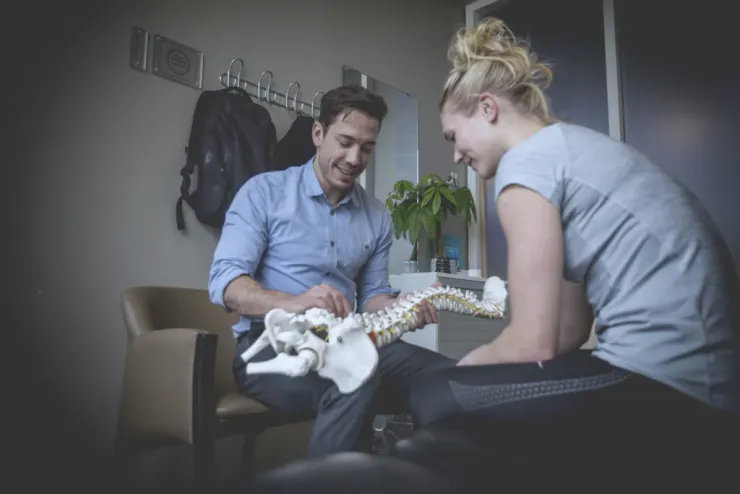
You come to Embody Health Chiropractie without a referral; your first visit costs €39. After the intake and the examination you hear straight away whether chiropractic care suits your situation. Most Dutch health insurers (partially) reimburse chiropractic care from the supplementary package, without touching your deductible.
“So so happy! I can sleep through the night again and have no more pain. Absolutely recommended:)”

Symptoms: where pelvic girdle pain sits and how it feels
The pain sits differently from person to person, and rarely in one spot. It is often worse when you are walking, going up or down stairs, standing on one leg, turning over in bed, or moving your legs apart, for example when you get out of a car. Sometimes it is a nagging pain that lingers, sometimes a sharp pain that comes on suddenly. It is often one-sided, for example in the right buttock, and in some women the pain radiates into the legs. Some women feel or hear a clicking or grinding in the pelvic area, and lying still is often the moment when you notice it least. Do you recognise any of these patterns?
- pain over the pubic bone at the front, roughly level with your hips
- pain across one or both sides of your lower back
- pain in the perineum, or spreading into your thighs
- pain when walking, on stairs, or standing on one leg
- trouble with everyday things such as turning over in bed or getting out of a car
Pain over the pubic bone
The pubic bone is the front of your pelvis, in the centre roughly level with your hips. Pain there often shows up when you lift a leg, climb stairs, or turn over in bed. Because this spot sits so centrally, the pain can feel as though it fills the whole pelvis.
Pain in the lower back and sacrum
At the back of the pelvis sits the sacrum, where the spine rests. Pelvic girdle pain there often feels like low back pain that moves with the pelvis and not with the lower back alone. Low back pain and pelvic girdle pain look alike, but they sometimes need a different approach; that is why we look at both.
Walking with a waddle
When walking hurts, you start moving your pelvis differently. That can give a waddling walk and makes stairs and standing for long periods harder. The hips and the muscles around the pelvis then tighten further, which spreads the complaints.
What causes pelvic pain in pregnancy: uneven joints and the baby's weight or position
It is not known exactly why pelvic pain affects some women. Pelvic pain can arise from a combination of factors, and pelvic girdle pain is one of the most common complaints in pregnancy. Not every woman is affected to the same degree, and the severity of the complaints varies. Pregnancy related pelvic girdle pain is thought to be linked to a number of issues, including the pelvic joints moving unevenly, and the weight or position of your baby. Things that can make pelvic girdle pain more likely include a history of lower back or pelvic girdle pain, having it in a previous pregnancy, a physically demanding job, or being overweight. The cause of pelvic pain differs from person to person.
Pregnancy hormones and the pelvic ligaments
During pregnancy the ligaments that hold the bones of the pelvis together become softer, and lose part of their firmness, so that there is room for the birth. Hormonal changes play a part in that, and the growth of the baby changes the load on the pelvis. A looser pelvis can give instability of the pelvis: the joints move a little too much, which hurts around the pelvis and in the pelvic region.
A previous pregnancy and heavier load
If you had pelvic girdle pain in a previous pregnancy, you are more likely to develop it again. A physically demanding job, being overweight, or an earlier injury to the pelvis can also play a part. Where the complaints sit exactly varies: they usually sit around the pelvis and the SI joint, not in the spine itself.
When should you see a doctor of chiropractic — and when do we involve your midwife?
A first appointment at Embody Health always begins with a thorough intake. We carefully check whether there are any warning signs that require a doctor's review first. Pelvic pain during pregnancy is usually harmless, but we look out for the rare signals that need medical attention. If you have unusual symptoms, always consult your midwife or gynaecologist first.
In most cases, pelvic pain during pregnancy is harmless and responds well to treatment. We look out for the uncommon causes that require immediate attention. Usually, the news is reassuring. Watch for these five signals:
- sudden severe pain in the pelvis or hip with an inability to bear weight on the leg
- loss of control over your bladder or bowels
- fever combined with pain in a joint
- pain when urinating together with feeling unwell or a fever
- during pregnancy: bleeding, contractions or reduced movement of your baby — contact your midwife or gynaecologist immediately
If you notice any of these signs, contact us right away. You can also reach us on WhatsApp. Our front desk will alert the chiropractor immediately if it seems urgent. If you're unsure, speak with your midwife, your GP, or our team.
Did you know most Dutch health insurers (partially) reimburse chiropractic care without touching your deductible?
Check your coverTreatment for pelvic girdle pain: during pregnancy and after the birth
Research on chiropractic care for pregnancy-related pelvic pain does not provide a definitive answer. There are, however, cautious indications that certain treatments may be beneficial. This aligns with what we observe in daily practice. During the intake and physical examination, we assess how your pelvis and SI joint move, how your back and pelvic floor muscles feel, and how you walk. Through gentle, precise adjustments, we aim to improve movement in the pelvis and surrounding muscles and give the pelvis more stability. The goal is to make movement smoother and reduce pain, which happens faster for some women than for others.
Our chiropractic care focuses on how your pelvis and the SI joint move. Movement and targeted exercises are at the core of the approach to pelvic girdle pain; that exercise therapy may also be guided by a pelvic physiotherapist, and you do not need a referral for it. For tight buttock or hip muscles, or a stiff pelvic region, manual therapy can fit alongside it. What helps differs from person to person, and so does the severity of the complaints. That is why we draw up a treatment plan together: which approach suits you, and how you pick up your daily activities again step by step.
For most women the symptoms ease after the birth. Pelvic girdle pain tends not to clear completely until the baby is born, though treatment from an experienced practitioner can improve the symptoms during pregnancy. Around a third of women still have symptoms three months after birth, and for a small group they last longer. If the pain stays for a long time, we speak of chronic pelvic pain: a form of pain in which recovery takes a long time, during and after pregnancy too. If it troubles you a lot, discuss it with your GP. They can think it through with you and, for long-lasting complaints, refer you to specialist care.
Pelvic complaints in pregnancy often need more than one approach. We always coordinate pregnancy care with your midwife or GP. When exercise therapy fits alongside the treatment, we coordinate that with your physiotherapist, so that you are not following two separate tracks.
Your first visit costs €39; a single follow-up consultation costs €65 and a consult in a recovery package €55. See what your health insurer covers and our prices.
What you can do yourself
First, remember that nothing breaks: the pain is unpleasant, but not dangerous, even on days when it hurts more. Staying active is needed to keep your condition and your muscle strength up. Keep moving, for example by walking or swimming. If it hurts more, rest for a moment and then pick it up again gently: it is important to find a balance between rest and activity. Research shows that exercise during pregnancy reduces the severity of back and pelvic girdle pain, although it does not prevent it. Some activities cost a lot of energy, even when they do not look heavy. Spread heavy tasks across the day, or ask someone to help.
Watch how you lift and how you get up from a chair or out of bed. Bend your knees when you pick something up, and sit down to get dressed. Getting in and out of the car is easier with your knees together. Wear supportive shoes, stand with equal weight on each leg, and put a pillow between your legs for extra support in bed. Avoid sitting or standing for long periods, too many stairs, and lifting heavy objects such as shopping bags. It helps to find a posture in which you sit upright, and to find a chair in which you can sit comfortably.
A pelvic support belt around your hips is often tried, but there is no proof that it helps. Crutches can make getting around easier.
Also pay attention to the pain signals from your body: women often know their own pain limits well, and pain and tiredness are a signal to take a rest. Take the rest you need to recover, and build up gently afterwards. Do the complaints keep up? Read more about pain in the buttock. If you want to know what we can do for you, book a first visit and we will look at the best approach together.
Frequently Asked Questions
What does a pelvic girdle pain treatment cost?
Your first visit costs €39. Follow-up consultations are €65 (single) or €55 per consult in a package; child consultations are €35. Most Dutch health insurers (partially) cover chiropractic care from the supplementary package.
What is pelvic girdle pain in pregnancy?
Pelvic girdle pain, sometimes called PGP, is pain around the pelvis during pregnancy. It comes from stiffness of the pelvic joints, or from those joints moving unevenly at the back or the front of the pelvis. You may feel it over the pubic bone at the front, across your lower back, in the perineum, or spreading into your thighs. It is not harmful to your baby, but it can be painful and make it hard to get around.
What can I do myself about pelvic pain in pregnancy?
Keep active, but avoid the things that make the pain worse, and rest when you need to. Wear supportive shoes, stand with equal weight on each leg, sit down to get dressed, and keep your knees together getting in and out of the car. A pillow between your legs in bed gives extra support. Avoid sitting or standing for long periods, too many stairs, and lifting heavy objects such as shopping bags.
How long does pelvic girdle pain last after birth?
Most women find the symptoms ease after the birth, though around a third still have symptoms three months later, and for a small group they last longer. If it troubles you a lot, discuss it with your GP or midwife.
Can a chiropractor help with pelvic girdle pain during pregnancy?
Yes, many expectant mothers experience relief from pelvic and SI complaints with chiropractic care. Because your safety comes first, we always work in consultation with your midwife or gynaecologist during pregnancy. During the first visit we thoroughly assess whether chiropractic care suits your situation before we start any treatment.
Is chiropractic care safe during pregnancy?
Chiropractic care during pregnancy is a common and usually gentle form of care that takes account of your body and your growing baby. Our treatments are adapted to your situation and always coordinated with your midwife or gynaecologist. In the first consultation we discuss your full history, so that together we decide what suits you.
Do I need to see a GP first for pelvic pain?
No, usually you do not: you can come to us without a referral. A few signals do need medical assessment first, such as bleeding or contractions during pregnancy, reduced movement of your baby, or pain when urinating with a fever. During pregnancy we always consult your midwife or gynaecologist about unusual complaints. We screen for those signals during the first visit and refer you straight on when that is needed.
Sources
- NHS: Pelvic pain in pregnancy — what pelvic girdle pain is, the symptoms, self-help advice and when to call your midwife or GP (accessed 05-11-2026).
- Cambridge University Hospitals: Pelvic girdle pain (PGP) in pregnancy — patient guidance on posture, sitting, lifting, stairs and pacing activity with pelvic girdle pain during pregnancy (accessed 05-11-2026).
- Exercise for the prevention and treatment of low back, pelvic girdle and lumbopelvic pain during pregnancy: a systematic review and meta-analysis (2019) — exercise during pregnancy reduces the severity of back and pelvic girdle pain, but does not lower the odds of developing it (accessed 05-11-2026).
- Prognostic factors for pregnancy-related pelvic girdle pain, a systematic review (2018) — about a third of women still have symptoms three months after birth, and for a small group they last longer (accessed 05-11-2026).
- Chiropractic Care for Adults With Pregnancy-Related Low Back, Pelvic Girdle Pain, or Combination Pain: A Systematic Review (2020) — no conclusive evidence, but cautious, favourable indications for a number of treatments around pregnancy (accessed 05-11-2026).
- European guidelines for the diagnosis and treatment of pelvic girdle pain (2008) — guidelines for the classification and management of pelvic girdle pain, with the emphasis on movement and exercise therapy (accessed 05-11-2026).
Next time you search, get an answer this clear again — add Embody to your preferred sources.