Pelvic Girdle Pain in Pregnancy: Causes and What Helps
Pelvic girdle pain or pelvic pain in pregnancy? Read what causes it, what you can do yourself, and when physiotherapy or chiropractic care helps.

What is pelvic girdle pain?
Pelvic girdle pain is pain in or around the pelvis. In pregnancy it sits over the pubic bone at the front, across your lower back, in the area between the vagina and anus, or spreading into your thighs. It is sometimes called pregnancy-related pelvic girdle pain (PGP) or symphysis pubis dysfunction (SPD). The pain comes from stiffness of the pelvic joints, or from those joints moving unevenly at either the back or the front of your pelvis. Pelvic girdle pain is not harmful to your baby, but it can be painful and make it hard to get around. Up to 1 in 5 pregnant women are affected to some degree.
You come to Embody Health Chiropractie without a referral; your first visit costs €39. After the intake and the examination you hear straight away whether chiropractic care suits your situation. Most Dutch health insurers (partially) reimburse chiropractic care from the supplementary package, without touching your deductible.
In Alphen aan den Rijn, Amersfoort and Rotterdam we have guided more than 2500 people with back, neck and joint complaints over the past twelve years. Patients rate us on average 4.9 out of 5 stars on Google.
“So so happy! I can sleep through the night again and have no more pain. Absolutely recommended:)”

What other pelvic complaints are there?
Pelvic pain in pregnancy is not the only pelvic complaint. Problems in the pelvic area — the region between your hips, low at the back and all around the pelvis — come in several forms, in women and in men. They often arise when the muscles and ligaments of the pelvic floor become weaker or get damaged. The best known are pelvic organ prolapse, urinary incontinence and coccyx (tailbone) pain.
Pelvic organ prolapse
In pelvic organ prolapse, one or more organs — the womb, the bladder or the bowel — no longer sit in the right place, because the muscles and ligaments of the pelvic floor have weakened. That can cause problems going to the toilet or during sex, and a feeling of heaviness or pressure in the vagina. It becomes more common as you get older, particularly after the menopause, and pregnancy and childbirth, being overweight, long-term constipation and straining, and a persistent cough all play a part. Pelvic floor muscle training, a vaginal support pessary or, for a severe prolapse, surgery can help. If your symptoms look like this, discuss them with your GP.
Urinary incontinence
Urinary incontinence means you cannot hold your urine well. The most common type is stress incontinence: urine leaks when your bladder is under pressure, for example when you cough, sneeze, laugh, lift or exercise, because the pelvic floor muscles and the muscle that closes the urethra have weakened. Pregnancy and vaginal birth, being overweight and getting older all raise the chance of it. Pelvic floor exercises are the first step, and bladder training can help with a sudden, intense urge. If simple measures are not enough, your GP can discuss other options. Tell your GP if it keeps troubling you.
Coccyx (tailbone) pain
Your coccyx is the small bone at the very bottom of your spine. It helps you sit: it is one leg of the tripod, with the sitting bones, that carries your weight when you are seated. In coccyx pain the pain sits in the middle of the buttocks, just above the anus, and is often worse when sitting and when standing up again. It usually follows a hard fall or comes from lasting pressure, for example from sitting or cycling for long periods. Conservative care works in most cases, and many people recover without treatment. If the pain still troubles you after a couple of months, or you have it during ordinary daily activities, see your GP.
What does pelvic girdle pain feel like?
The pain sits differently from person to person, and rarely in one spot. It is often worse when you are walking, going up or down stairs, standing on one leg, turning over in bed, or moving your legs apart, for example when you get out of a car. Sometimes it is a nagging pain that lingers, sometimes a sharp pain that comes on suddenly. It is often one-sided, for example in the right buttock, and in some women the pain radiates into the legs. Some women feel or hear a clicking or grinding in the pelvic area, and lying still is often the moment when you notice it least. Do you recognise any of these patterns?
- pain over the pubic bone at the front, roughly level with your hips
- pain across one or both sides of your lower back
- pain in the perineum, or spreading into your thighs
- pain when walking, on stairs, or standing on one leg
- trouble with everyday things such as turning over in bed or getting out of a car
Pain over the pubic bone
The pubic bone is the front of your pelvis, in the centre roughly level with your hips. Pain there often shows up when you lift a leg, climb stairs, or turn over in bed. Because this spot sits so centrally, the pain can feel as though it fills the whole pelvis.
Pain in the lower back and sacrum
At the back of the pelvis sits the sacrum, where the spine rests. Pelvic girdle pain there often feels like low back pain that moves with the pelvis and not with the lower back alone. Low back pain and pelvic girdle pain look alike, but they sometimes need a different approach; that is why we look at both.
Walking with a waddle
When walking hurts, you start moving your pelvis differently. That can give a waddling walk and makes stairs and standing for long periods harder. The hips and the muscles around the pelvis then tighten further, which spreads the complaints.
Pelvic girdle pain and low back pain
Pelvic girdle pain and low back pain often overlap, and the type of pain differs from woman to woman: some feel a nagging ache, others a sharp stab. The pelvic girdle is the ring of bones and joints at the base of your spine, and the symptoms of pelvic girdle pain can also spread to your hips and thighs. Complaints like these are common during pregnancy, and pregnancy-related pelvic pain usually eases after the birth.
What causes pelvic pain and pelvic complaints in pregnancy?
It is not known exactly why pelvic pain affects some women. Pelvic pain can arise from a combination of factors, and pelvic girdle pain is one of the most common complaints in pregnancy. Not every woman is affected to the same degree, and the severity of the complaints varies. Pregnancy related pelvic girdle pain is thought to be linked to a number of issues, including the pelvic joints moving unevenly, and the weight or position of your baby. Things that can make pelvic girdle pain more likely include a history of lower back or pelvic girdle pain, having it in a previous pregnancy, a physically demanding job, or being overweight. The cause of pelvic pain differs from person to person.
Pregnancy hormones and the pelvic ligaments
During pregnancy the ligaments that hold the bones of the pelvis together become softer, and lose part of their firmness, so that there is room for the birth. Hormonal changes play a part in that, and the growth of the baby changes the load on the pelvis. A looser pelvis can give instability of the pelvis: the joints move a little too much, which hurts around the pelvis and in the pelvic region.
A previous pregnancy and heavier load
If you had pelvic girdle pain in a previous pregnancy, you are more likely to develop it again. A physically demanding job, being overweight, or an earlier injury to the pelvis can also play a part. Where the complaints sit exactly varies: they usually sit around the pelvis and the SI joint, not in the spine itself.
First: rule out serious signals
Every first visit at Embody Health starts with a careful screening for the signals that need medical assessment. Most pelvic pain in pregnancy is harmless and temporary, and we always screen first for the few signals that really need attention. Call your midwife or GP if you have pelvic girdle pain during pregnancy and moving around gets hard, if it hurts to get out of a car or turn over in bed, or if stairs are painful. Are you pregnant? With unusual complaints, consult your midwife or gynaecologist first.
Most pelvic pain in pregnancy is harmless and well treatable. We screen for the rare causes that really need attention, and most of the time the answer is good news. Five signals deserve attention the same day:
- sudden severe pain in the pelvis or hip with an inability to bear weight on the leg
- loss of control over your bladder or bowels
- fever combined with pain in a joint
- pain when urinating together with feeling unwell or a fever
- during pregnancy: bleeding, contractions or reduced movement of your baby — contact your midwife or gynaecologist immediately
If any of these apply, call us the same day; we are also reachable on WhatsApp, and our front desk alerts the chiropractor straight away when it looks urgent. Not sure? Talk it through with your midwife, your GP or with us.
Did you know most Dutch health insurers (partially) reimburse chiropractic care without touching your deductible?
Check your coverTreatment at Embody Health
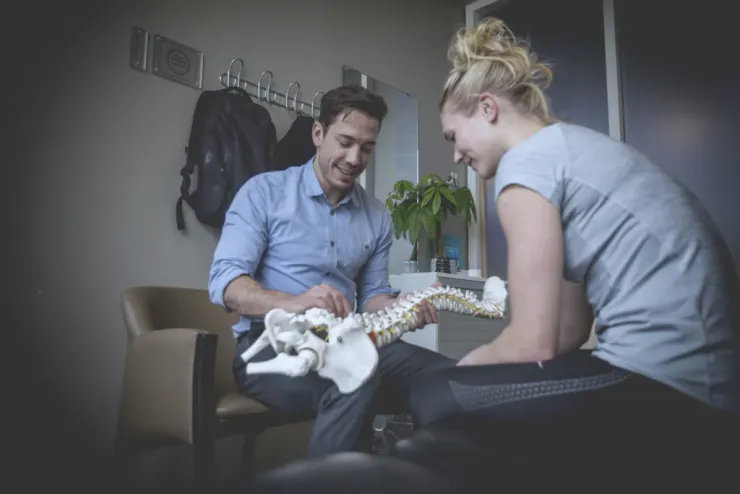
What does the research say about treatment for pelvic girdle pain? A systematic review of chiropractic care for pregnancy-related low back and pelvic girdle pain found no conclusive evidence, but it did find cautious, favourable indications for a number of treatments. That fits what we see in practice. During the intake and physical examination we look at how the pelvis and the SI joint move, at the tension in the back and pelvic floor muscles, and at the way you walk. With gentle, precise corrections we restore the movement of the pelvis and the muscles around it. The aim is that moving becomes easier and the pain eases, faster for one person than for another.
Physiotherapy for your pelvis and back can help with the pain: it may include pelvic floor exercises and exercises to strengthen your stomach, back and hip muscles, and you learn to cope better with the complaints. This therapy is often given by a pelvic physiotherapist, and you do not need a referral for it. In pelvic physiotherapy you work with specific exercises on your muscle strength and on the balance between load and capacity, to prevent muscle weakness. Our chiropractic care focuses on the movement of the pelvis and the SI joint; the exercise therapy builds your load tolerance. Pelvic complaints are a common problem, and the cause and severity differ from person to person: what helps depends on the cause. That is why we draw up a treatment plan together and look at which approach suits you, and at how you pick up your daily activities again step by step, with the aim of easing your complaints. For tight buttock or hip muscles, or a stiff pelvic region, manual therapy can fit alongside the exercise therapy.
For most women the symptoms ease after the birth. Pelvic girdle pain tends not to clear completely until the baby is born, though treatment from an experienced practitioner can improve the symptoms during pregnancy. Around a third of women still have symptoms three months after birth, and for a small group they last longer. If the pain stays for a long time, we speak of chronic pelvic pain: a form of pain in which recovery takes a long time, during and after pregnancy too. If it troubles you a lot, discuss it with your GP, who can refer you to a pelvic physiotherapist and, for long-lasting complaints, to a team of practitioners in hospital.
Pelvic complaints in pregnancy often need more than one approach. We always coordinate pregnancy care with your midwife or GP. When exercise therapy fits alongside the treatment, we coordinate that with your physiotherapist, so that you are not following two separate tracks.
Your first visit costs €39; a single follow-up consultation costs €65 and a consult in a recovery package €55. See what your health insurer covers and our prices.
What you can do yourself
First, remember that nothing breaks: the pain is unpleasant, but not dangerous, even on days when it hurts more. Staying active is needed to keep your condition and your muscle strength up. Keep moving, for example by walking or swimming. If it hurts more, rest for a moment and then pick it up again gently: it is important to find a balance between rest and activity. Research shows that exercise during pregnancy reduces the severity of back and pelvic girdle pain, although it does not prevent it. Some activities cost a lot of energy, even when they do not look heavy. Spread heavy tasks across the day, or ask someone to help.
Watch how you lift and how you get up from a chair or out of bed. Bend your knees when you pick something up, and sit down to get dressed. Getting in and out of the car is easier with your knees together. Wear supportive shoes, stand with equal weight on each leg, and put a pillow between your legs for extra support in bed. Avoid sitting or standing for long periods, too many stairs, and lifting heavy objects such as shopping bags. It helps to find a posture in which you sit upright, and to find a chair in which you can sit comfortably.
A physiotherapist may recommend a pelvic support belt to ease the pain, or crutches to help you get around. Research on support devices is not conclusive, so treat them as support rather than a cure.
Also pay attention to the pain signals from your body: women often know their own pain limits well, and pain and tiredness are a signal to take a rest. Take the rest you need to recover, and build up gently afterwards. Do the complaints keep up? Read more about pain in the buttock. Book a first visit and together we will see whether chiropractic care suits your situation, or whether another practitioner is the better first step.
Frequently Asked Questions
What does a pelvic girdle pain treatment cost?
Your first visit costs €39. Follow-up consultations are €65 (single) or €55 per consult in a package; child consultations are €35. Most Dutch health insurers (partially) cover chiropractic care from the supplementary package.
What is pelvic girdle pain in pregnancy?
Pelvic girdle pain, sometimes called PGP, is pain around the pelvis during pregnancy. It comes from stiffness of the pelvic joints, or from those joints moving unevenly at the back or the front of the pelvis. You may feel it over the pubic bone at the front, across your lower back, in the perineum, or spreading into your thighs. It is not harmful to your baby, but it can be painful and make it hard to get around.
What can I do myself about pelvic pain in pregnancy?
Keep active, but avoid the things that make the pain worse, and rest when you need to. Wear supportive shoes, stand with equal weight on each leg, sit down to get dressed, and keep your knees together getting in and out of the car. A pillow between your legs in bed gives extra support. Avoid sitting or standing for long periods, too many stairs, and lifting heavy objects such as shopping bags.
How long does pelvic girdle pain last after birth?
For most women the symptoms ease after the birth. Pelvic girdle pain tends not to clear completely until the baby is born, though treatment from an experienced practitioner can improve the symptoms during pregnancy. Around a third of women still have symptoms three months after birth, and for a small group they last longer. If it troubles you a lot, discuss it with your GP or midwife.
Can a chiropractor help with pelvic girdle pain during pregnancy?
Yes, many expectant mothers experience relief from pelvic and SI complaints with chiropractic care. Because your safety comes first, we always work in consultation with your midwife or gynaecologist during pregnancy. During the first visit we thoroughly assess whether chiropractic care suits your situation before we start any treatment.
Is chiropractic care safe during pregnancy?
Chiropractic care during pregnancy is a common and usually gentle form of care that takes account of your body and your growing baby. Our treatments are adapted to your situation and always coordinated with your midwife or gynaecologist. In the first consultation we discuss your full history, so that together we decide what suits you.
Can chiropractic care help with complaints after birth?
Yes. After birth the pelvis, lower back and hips can be temporarily overloaded or out of balance. Chiropractic care can help restore balance, for example with ongoing pelvic pain or stiffness. Always discuss complaints after birth with your midwife or GP first; during the first visit we then look together at what suits you.
Do I need to see a GP first for pelvic pain?
No, usually you do not: you can come to us without a referral. A few signals do need medical assessment first, such as bleeding or contractions during pregnancy, reduced movement of your baby, or pain when urinating with a fever. During pregnancy we always consult your midwife or gynaecologist about unusual complaints. We screen for those signals during the first visit and refer you straight on when that is needed.
Sources
- NHS: Pelvic pain in pregnancy — what pelvic girdle pain is, the symptoms, self-help advice and when to call your midwife or GP (accessed 05-11-2026).
- NHS: Pelvic organ prolapse — what pelvic organ prolapse is, the symptoms, the causes and the treatment options (accessed 05-11-2026).
- NHS: Urinary incontinence — the types of urinary incontinence, the causes, and pelvic floor exercises as the first treatment (accessed 05-11-2026).
- Coccydynia: an overview of the anatomy, etiology, and treatment of coccyx pain (2014) — the anatomy and seated weight-bearing role of the coccyx, and that conservative treatment succeeds in about 90% of cases (accessed 05-11-2026).
- Exercise for the prevention and treatment of low back, pelvic girdle and lumbopelvic pain during pregnancy: a systematic review and meta-analysis (2019) — exercise during pregnancy reduces the severity of back and pelvic girdle pain, but does not lower the odds of developing it (accessed 05-11-2026).
- Prognostic factors for pregnancy-related pelvic girdle pain, a systematic review (2018) — about a third of women still have symptoms three months after birth, and for a small group they last longer (accessed 05-11-2026).
- Chiropractic Care for Adults With Pregnancy-Related Low Back, Pelvic Girdle Pain, or Combination Pain: A Systematic Review (2020) — no conclusive evidence, but cautious, favourable indications for a number of treatments around pregnancy (accessed 05-11-2026).
- European guidelines for the diagnosis and treatment of pelvic girdle pain (2008) — classification and management of pelvic girdle pain, with movement and exercise therapy at the core (accessed 05-11-2026).
Next time you search, get an answer this clear again — add Embody to your preferred sources.